Blog
News, updates and analysis
Weekly leaderboard · Week 33 results (Aug 10 – Aug 16, 2026) · published Week 34
🎁 Weekly Pro Rewards
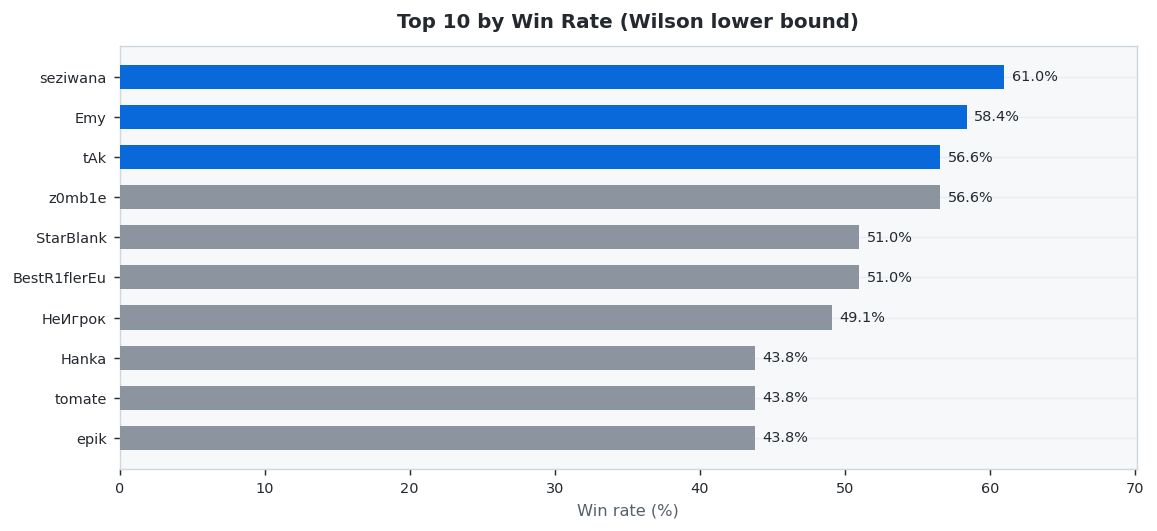
77 predictors placed 544 settled wagers this week (Week 33 results (Aug 10 – Aug 16, 2026) · published Week 34). seziwana led on accuracy at 61.0% Wilson, while Hanka netted +$12.17 in profit. Average accuracy across the field: 21.7%.
🎯 Win Rate Champion
Highest accuracy by Wilson lower bound (3+ settled wagers required to qualify).
💵 Profit Champion
Highest net USD return (winnings minus stakes). Green bars are winners, red are net losers.
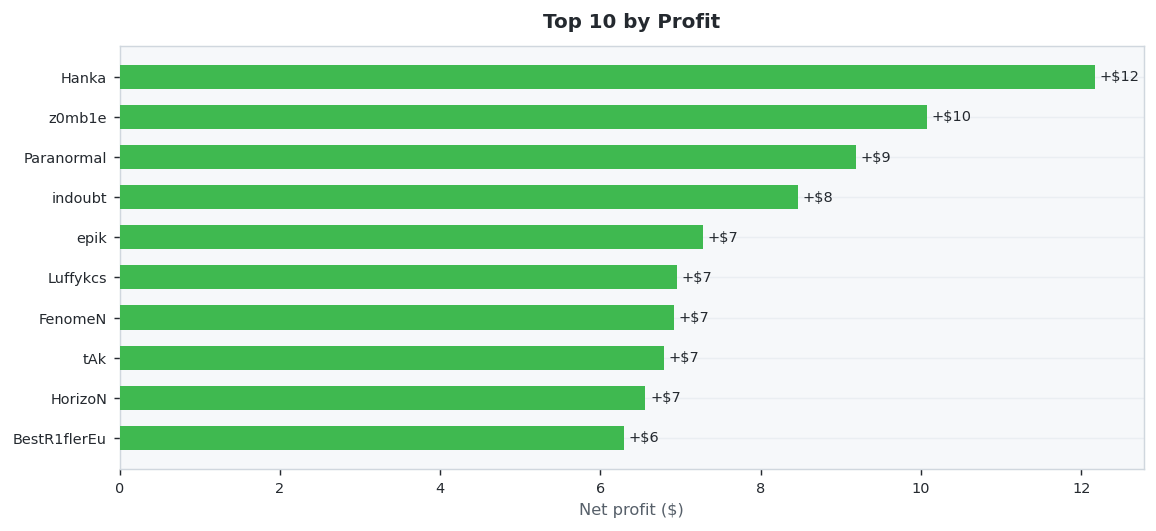
- 🥇 Hanka — +$12.17 (3 bets)
- 🥈 z0mb1e — +$10.07 (5 bets)
- 🥉 Paranormal — +$9.19 (4 bets)
Want next week's prize?
Top-1 in each category wins 1 month Pro. Place 3+ predictions on the match list · check the live leaderboard.
Weekly digest · Top-tier CS2 matches · Week 33 · Aug 03 – Aug 09, 2026
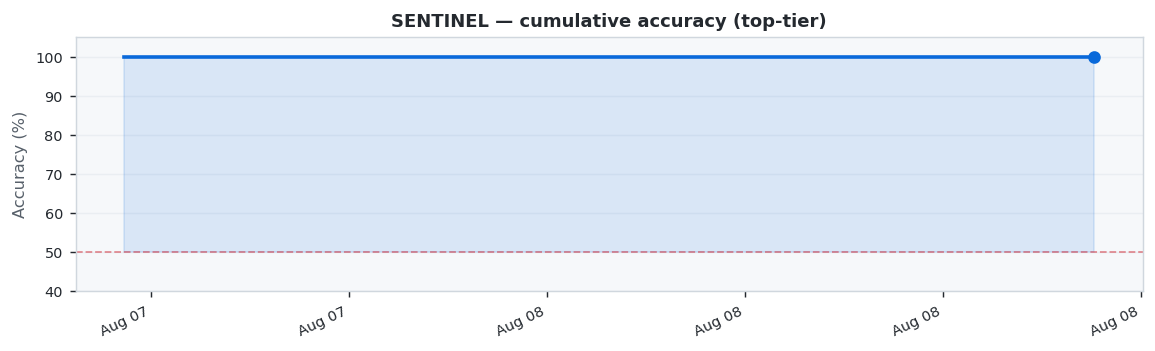
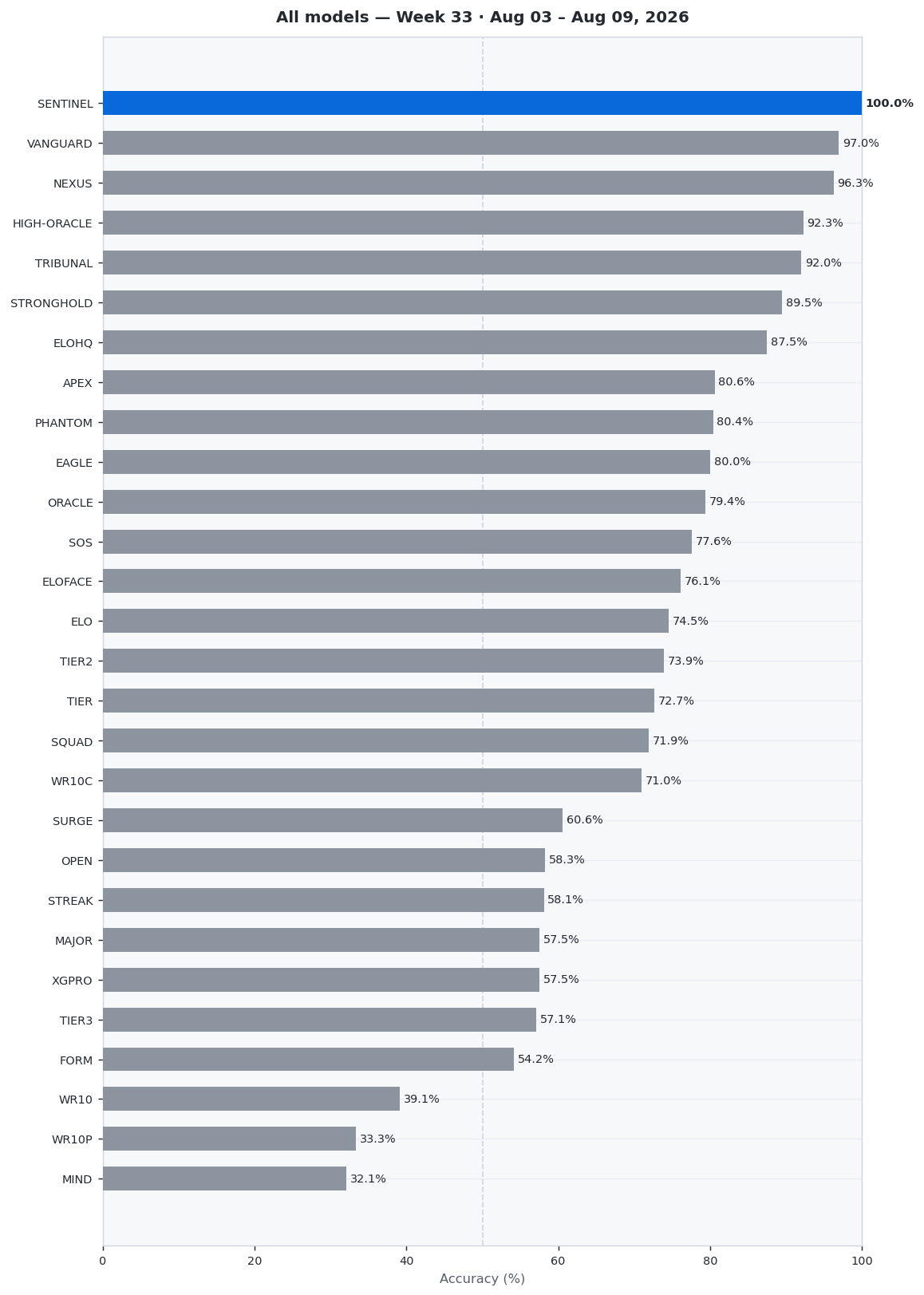
This week (Week 33 · Aug 03 – Aug 09, 2026) we analyzed 112 top-tier CS2 matches across 28 prediction models. SENTINEL dominated with 100.0% accuracy (13/13 correct), ahead of VANGUARD at 97.0%. SENTINEL achieved a Brier Score of 0.1347 and Log Loss of 0.4563.
🏆 Model of the Week: SENTINEL
SENTINEL had an outstanding week, correctly predicting 13 out of 13 matches.
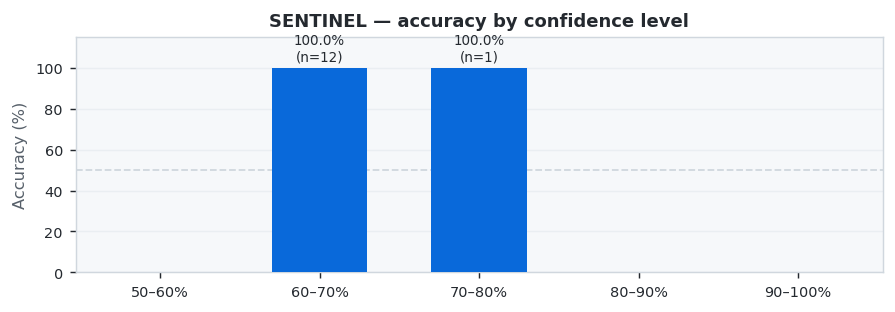
SENTINEL showed excellent performance with 100.0% accuracy across 13 predictions (13 correct, 0 wrong).
📊 Full Rankings This Week
Complete model performance for the week. The leader is highlighted.
🎮 SENTINEL Predictions This Week
13/13 correct predictions on top-tier matches.
| MATCH | PREDICTION | RESULT |
|---|---|---|
| GenOne 2-0 Galactik rebels | 65% GenOne | CORRECT |
| INFINITE 1-0 Giant Pandas | 62% INFINITE | CORRECT |
| Dark Tigre 0-2 SINNERS | 66% SINNERS | CORRECT |
| Partizan 2-0 Orion Wanderers | 64% Partizan | CORRECT |
| Sangal 2-0 Zeste | 65% Sangal | CORRECT |
| SadFamous 0-1 Eternal Fire | 62% Eternal Fi | CORRECT |
| Liquid 2-0 Dhala | 72% Liquid | CORRECT |
| EYEBALLERS 2-0 REVENIX | 60% EYEBALLERS | CORRECT |
| DENDELE 2-0 SAW | 63% DENDELE | CORRECT |
| QueenConso 0-2 EAC | 62% EAC | CORRECT |
| BIG 2-0 z to forward | 61% BIG | CORRECT |
| HOTU 2-0 Galactik rebels | 60% HOTU | CORRECT |
| HEROIC 2-0 REM | 63% HEROIC | CORRECT |
Weekly leaderboard · Week 32 results (Aug 03 – Aug 09, 2026) · published Week 33
🎁 Weekly Pro Rewards
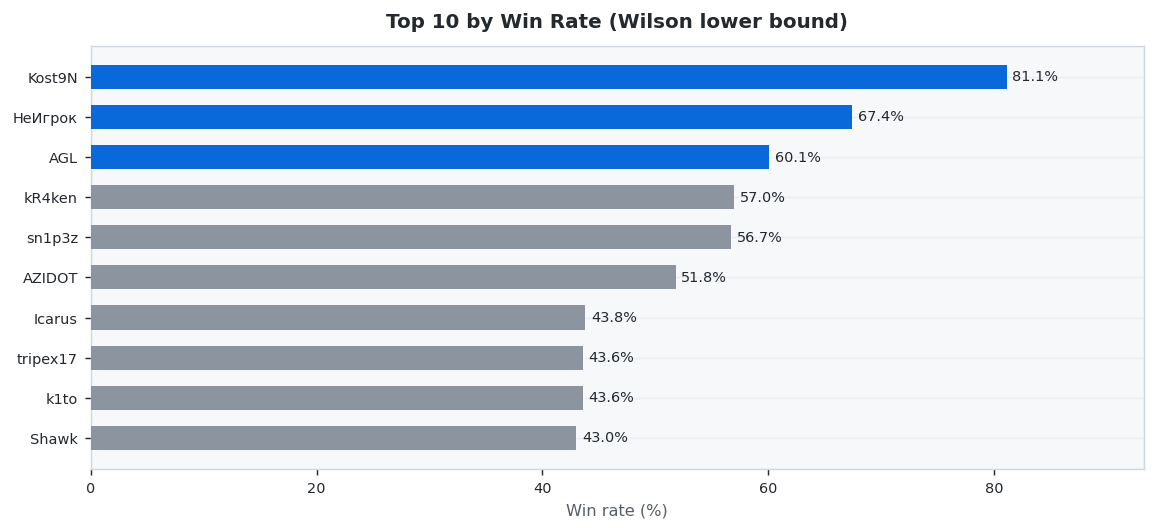
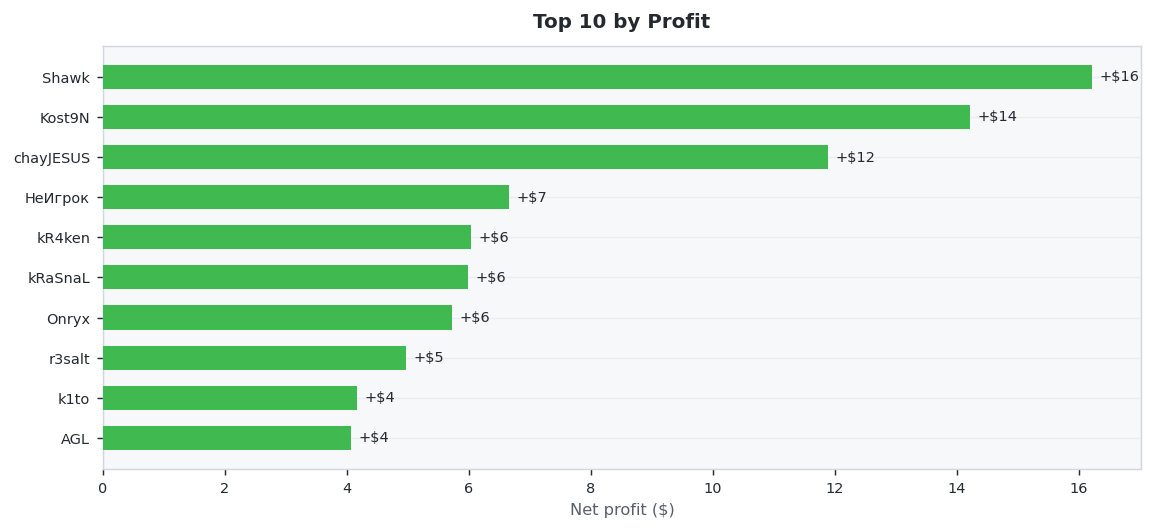
88 predictors placed 756 settled wagers this week (Week 32 results (Aug 03 – Aug 09, 2026) · published Week 33). Kost9N led on accuracy at 81.1% Wilson, while Shawk netted +$16.21 in profit. Average accuracy across the field: 23.1%.
🎯 Win Rate Champion
Highest accuracy by Wilson lower bound (3+ settled wagers required to qualify).
💵 Profit Champion
Highest net USD return (winnings minus stakes). Green bars are winners, red are net losers.
Want next week's prize?
Top-1 in each category wins 1 month Pro. Place 3+ predictions on the match list · check the live leaderboard.
Weekly digest · Top-tier CS2 matches · Week 32 · Jul 27 – Aug 02, 2026
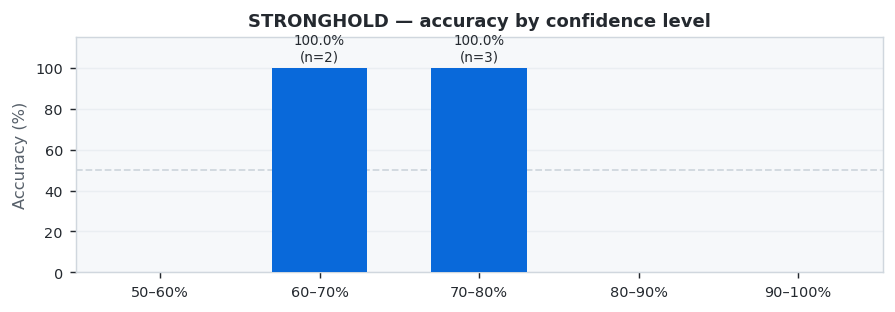
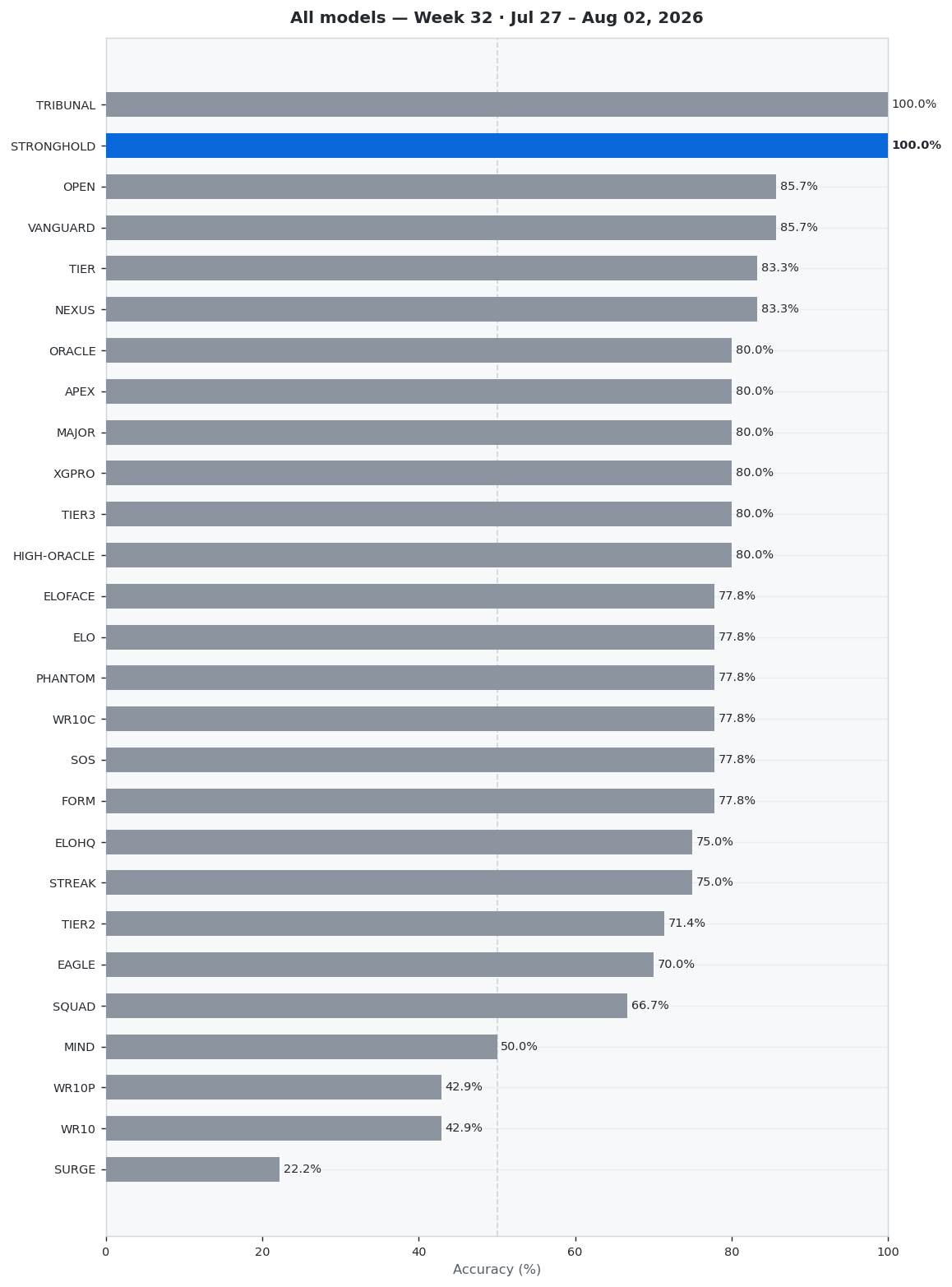
This week (Week 32 · Jul 27 – Aug 02, 2026) we analyzed 10 top-tier CS2 matches across 27 prediction models. STRONGHOLD dominated with 100.0% accuracy (5/5 correct), ahead of TRIBUNAL at 100.0%. STRONGHOLD achieved a Brier Score of 0.0819 and Log Loss of 0.3339.
🏆 Model of the Week: STRONGHOLD
STRONGHOLD had an outstanding week, correctly predicting 5 out of 5 matches.
STRONGHOLD showed excellent performance with 100.0% accuracy across 5 predictions (5 correct, 0 wrong).
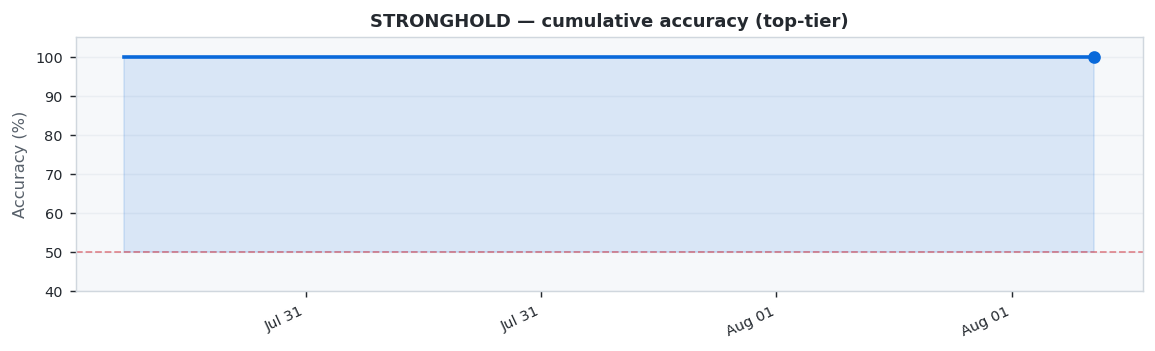
📊 Full Rankings This Week
Complete model performance for the week. The leader is highlighted.
🎮 STRONGHOLD Predictions This Week
5/5 correct predictions on top-tier matches.
| MATCH | PREDICTION | RESULT |
|---|---|---|
| Liquid 2-1 Betclic | 65% Liquid | CORRECT |
| FaZe 1-2 Spirit | 75% Spirit | CORRECT |
| 3DMAX 1-2 MOUZ | 74% MOUZ | CORRECT |
| Virtus.pro 2-1 BAKS | 68% Virtus.pro | CORRECT |
| Liquid 0-2 Spirit | 77% Spirit | CORRECT |
Weekly leaderboard · Week 31 results (Jul 27 – Aug 02, 2026) · published Week 32
🎁 Weekly Pro Rewards
91 predictors placed 757 settled wagers this week (Week 31 results (Jul 27 – Aug 02, 2026) · published Week 32). FromBehind led on accuracy at 67.2% Wilson, while FromBehind netted +$17.91 in profit. Average accuracy across the field: 21.2%.
🎯 Win Rate Champion
Highest accuracy by Wilson lower bound (3+ settled wagers required to qualify).
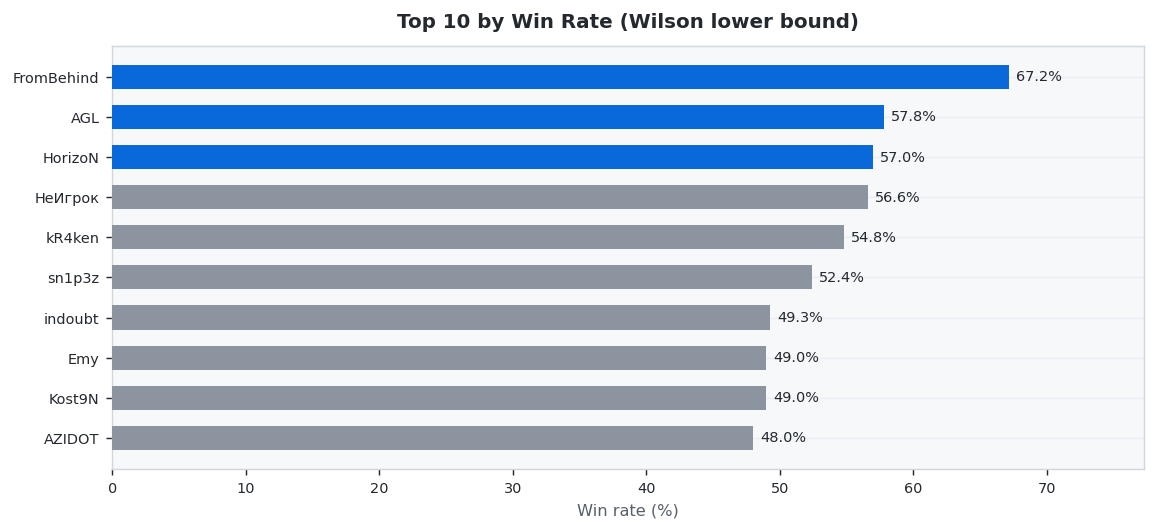
- 🥇 FromBehind — 67.2% Wilson (16W / 2L)
- 🥈 AGL — 57.8% Wilson (11W / 2L)
- 🥉 HorizoN — 57.0% Wilson (13W / 3L)
💵 Profit Champion
Highest net USD return (winnings minus stakes). Green bars are winners, red are net losers.
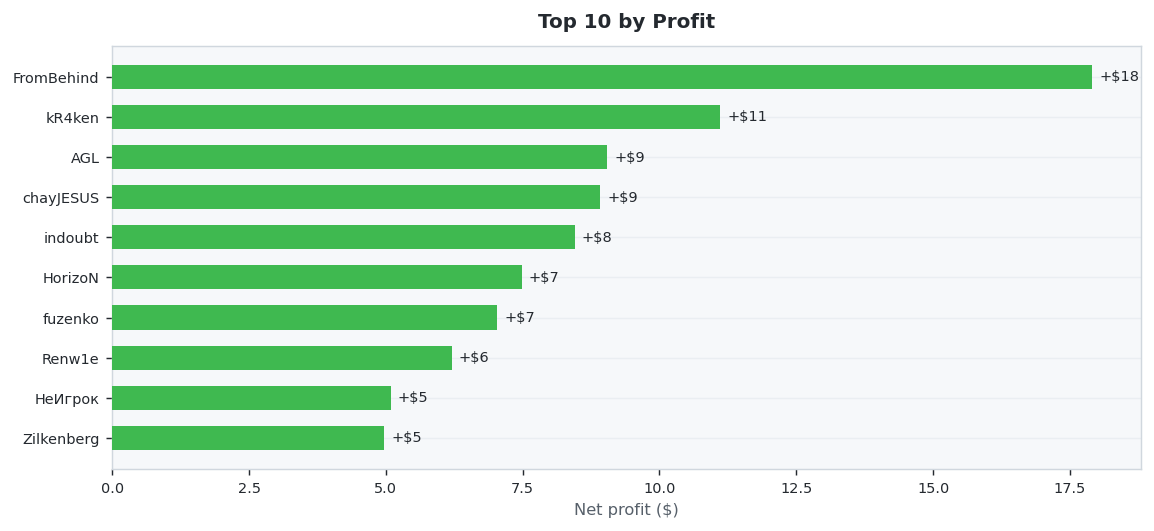
- 🥇 FromBehind — +$17.91 (18 bets)
- 🥈 kR4ken — +$11.11 (18 bets)
- 🥉 AGL — +$9.04 (13 bets)
Want next week's prize?
Top-1 in each category wins 1 month Pro. Place 3+ predictions on the match list · check the live leaderboard.
Monthly digest · Top-tier CS2 matches · August 2026
Based on July 2026 data, we tracked 135 top-tier CS2 matches across 28 prediction models with a total of 2362 predictions. The average model accuracy was 61.3%, with a spread of 34.6% between the best and worst performing models.
🏆 Top 3 Models of the Month
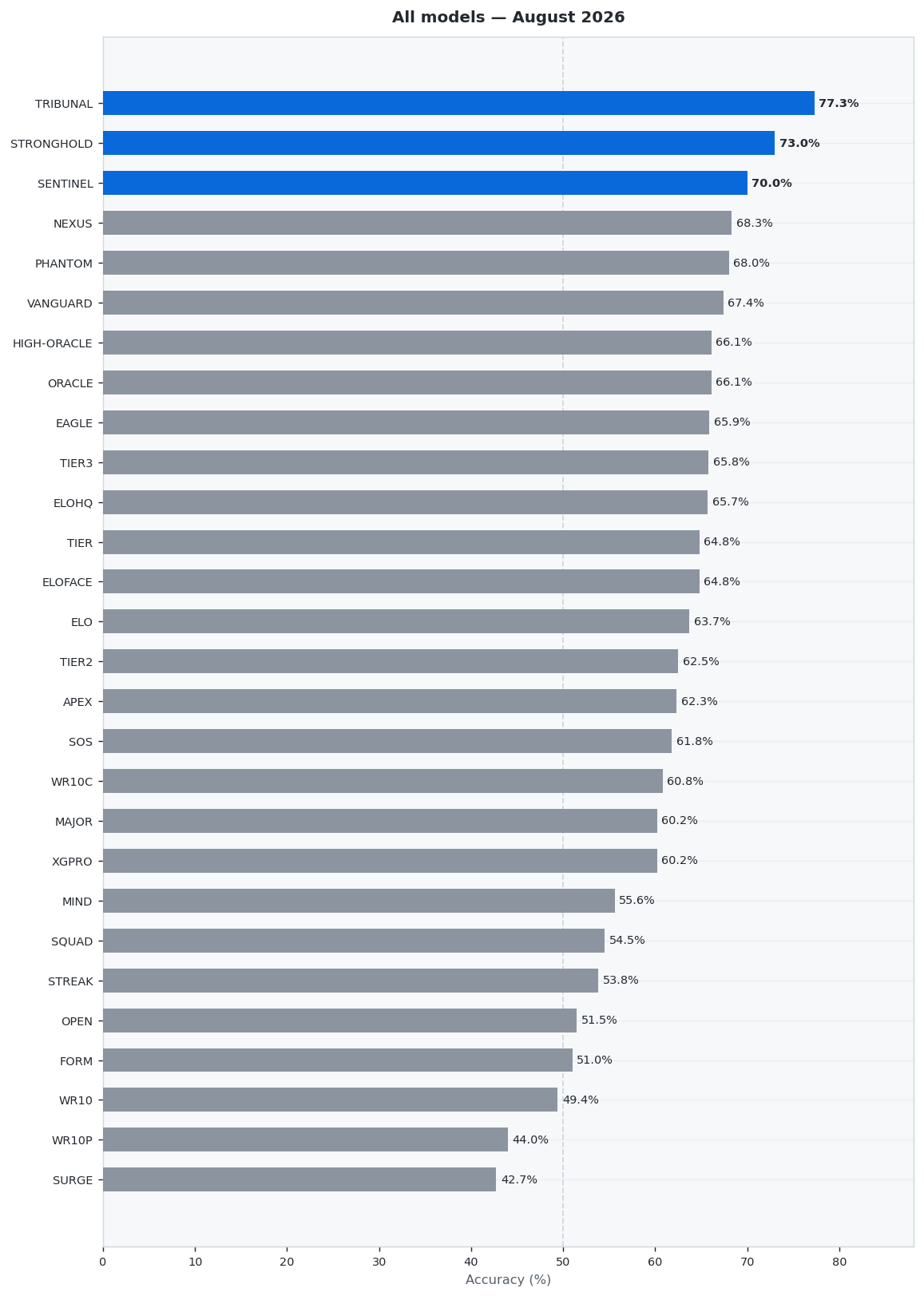
TRIBUNAL takes the top spot with 77.3% accuracy, followed by STRONGHOLD at 73.0% and SENTINEL at 70.0%.
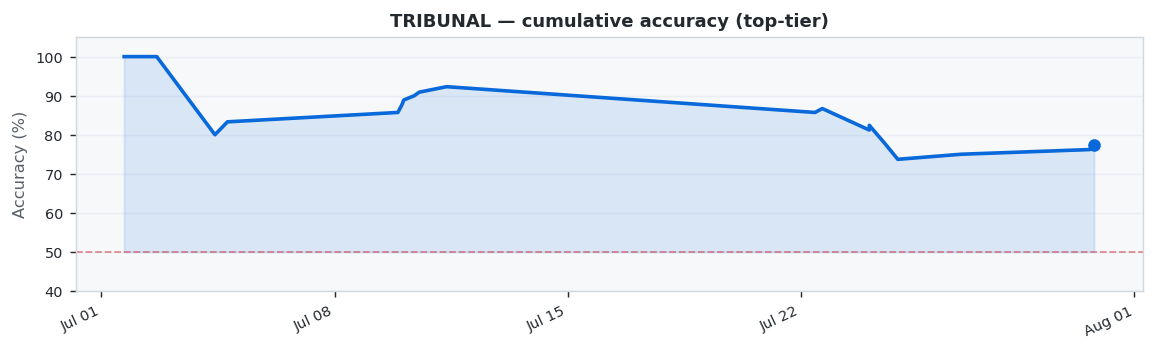
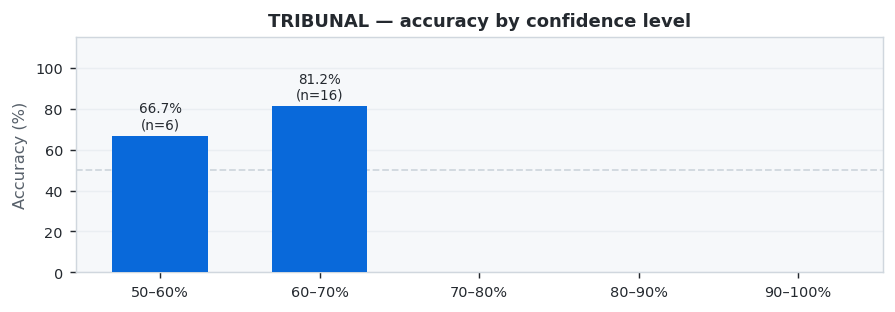
TRIBUNAL showed excellent performance with 77.3% accuracy across 22 predictions (17 correct, 5 wrong). Best week: W28 at 100.0%, weakest: W30 at 42.9%.
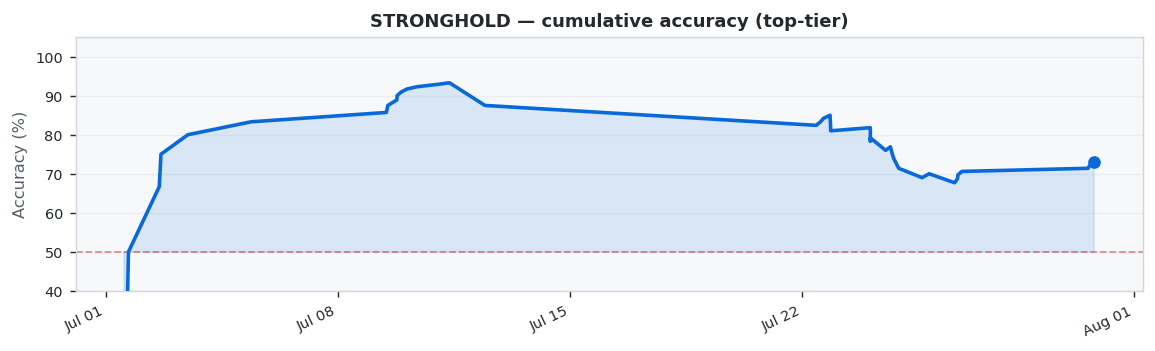
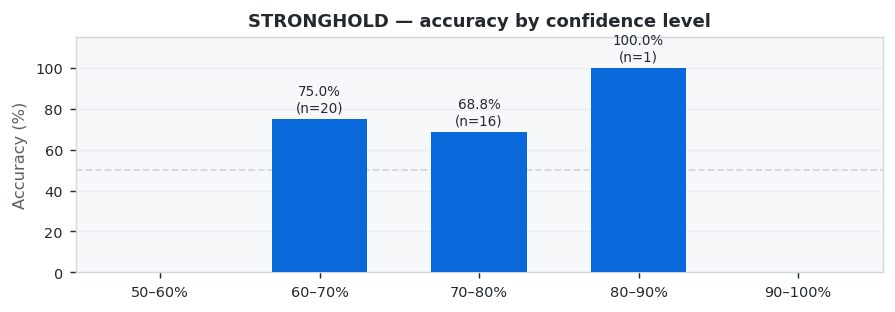
STRONGHOLD showed strong performance with 73.0% accuracy across 37 predictions (27 correct, 10 wrong). Best week: W31 at 100.0%, weakest: W30 at 55.6%.
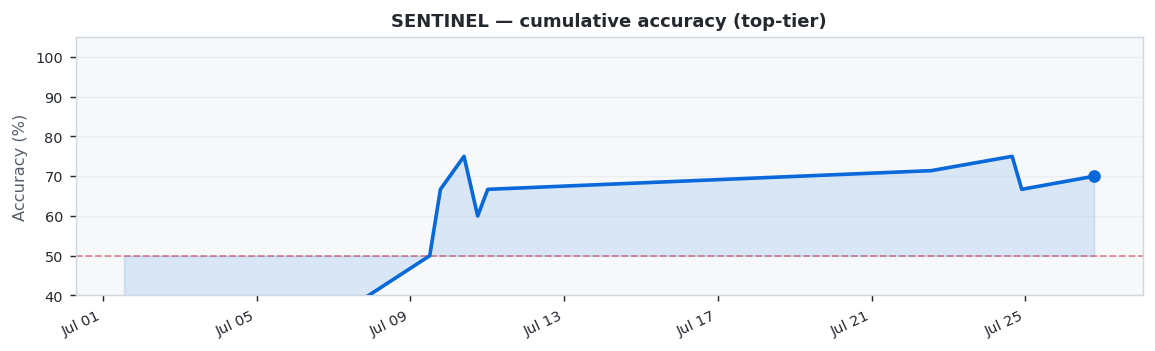
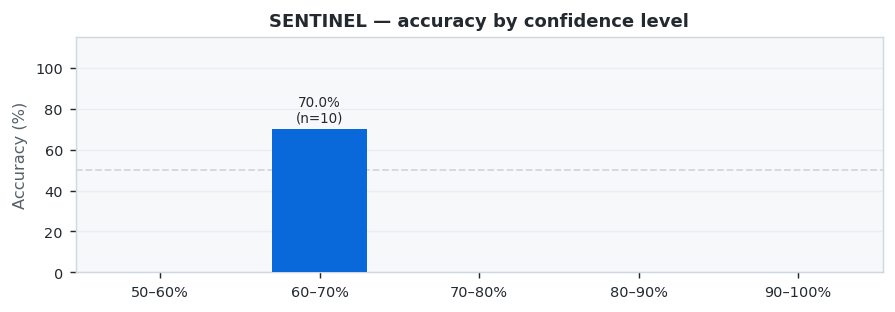
SENTINEL showed strong performance with 70.0% accuracy across 10 predictions (7 correct, 3 wrong). Best week: W28 at 80.0%, weakest: W27 at 0.0%.
📊 Full Monthly Leaderboard
Below is the complete ranking of all models. Models highlighted in blue are in the top 3. The bar chart shows relative performance at a glance.
Monthly leaderboard · July 2026 results · published August 2026
🎁 Monthly Pro Rewards
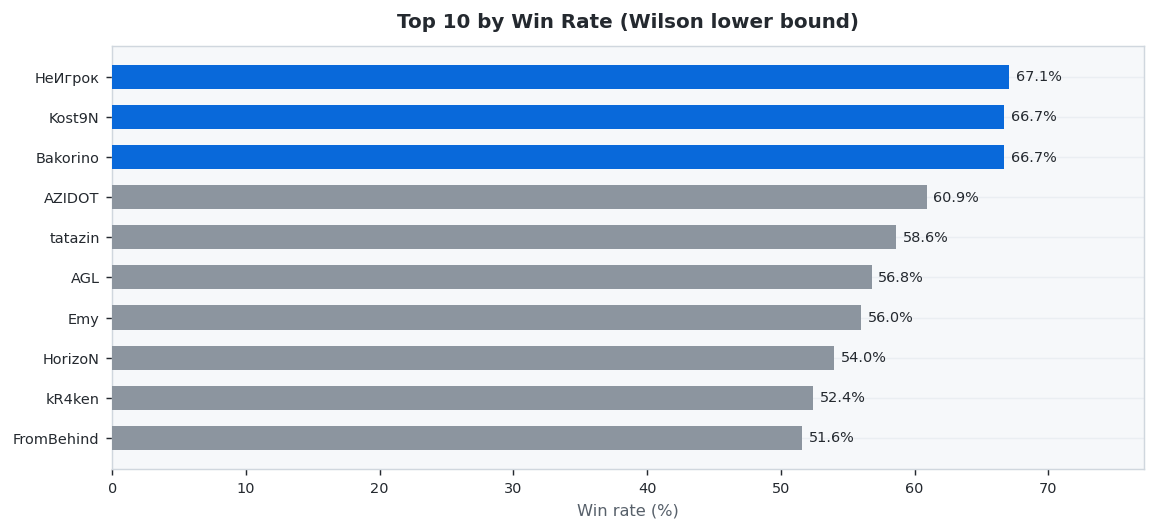
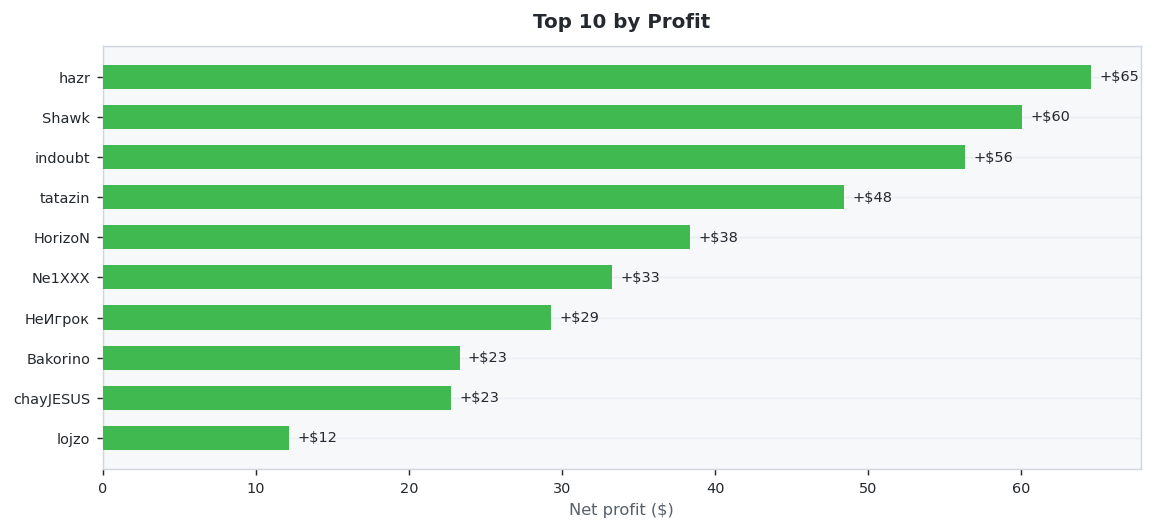
102 predictors placed 3409 settled wagers this month (July 2026 results · published August 2026). НеИгрок led on accuracy at 67.1% Wilson, while hazr netted +$64.57 in profit. Average accuracy across the field: 33.3%.
🎯 Win Rate Champion
Highest accuracy by Wilson lower bound (3+ settled wagers required to qualify).
💵 Profit Champion
Highest net USD return (winnings minus stakes). Green bars are winners, red are net losers.
Want next month's prize?
Top-1 in each category wins 2 months Pro. Place 3+ predictions on the match list · check the live leaderboard.
Product launch · July 2026
The team behind CS2PREDICT has launched a sister project: DOTA2PREDICT — the same AI-prediction engine, rebuilt for professional Dota 2.
What you get on dota2predict.gg:
- 19 AI models — Elo & head-to-head ratings, recent form, a draft XGBoost, hero-meta strength and their weighted ensemble;
- Free ensemble forecast on every pro match, updated in real time;
- Hero meta & retrospective trends — pick/ban/win-rate charts per hero;
- Pari-mutuel prediction pools with zero commission (Pro);
- Leaderboards — weekly, monthly and all-time.
One account, one balance. Your CS2PREDICT login and balance work on dota2predict.gg as-is — sign in with the same credentials and you are ready to go.
Weekly digest · Top-tier CS2 matches · Week 31 · Jul 20 – Jul 26, 2026
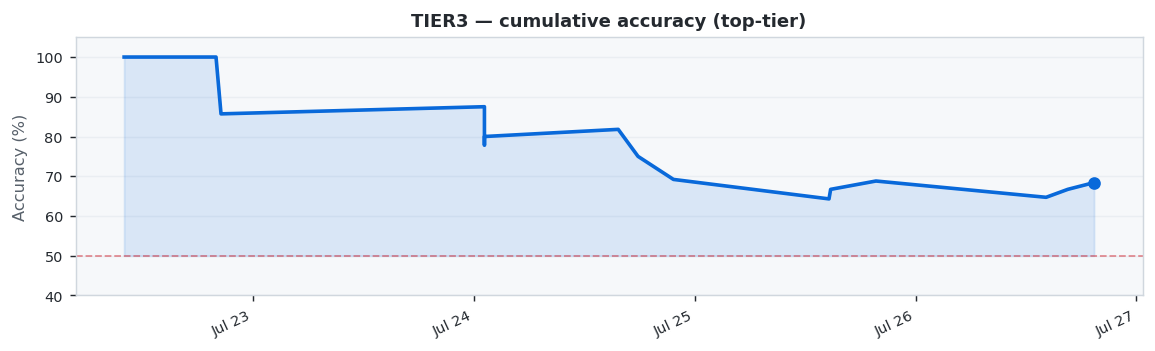
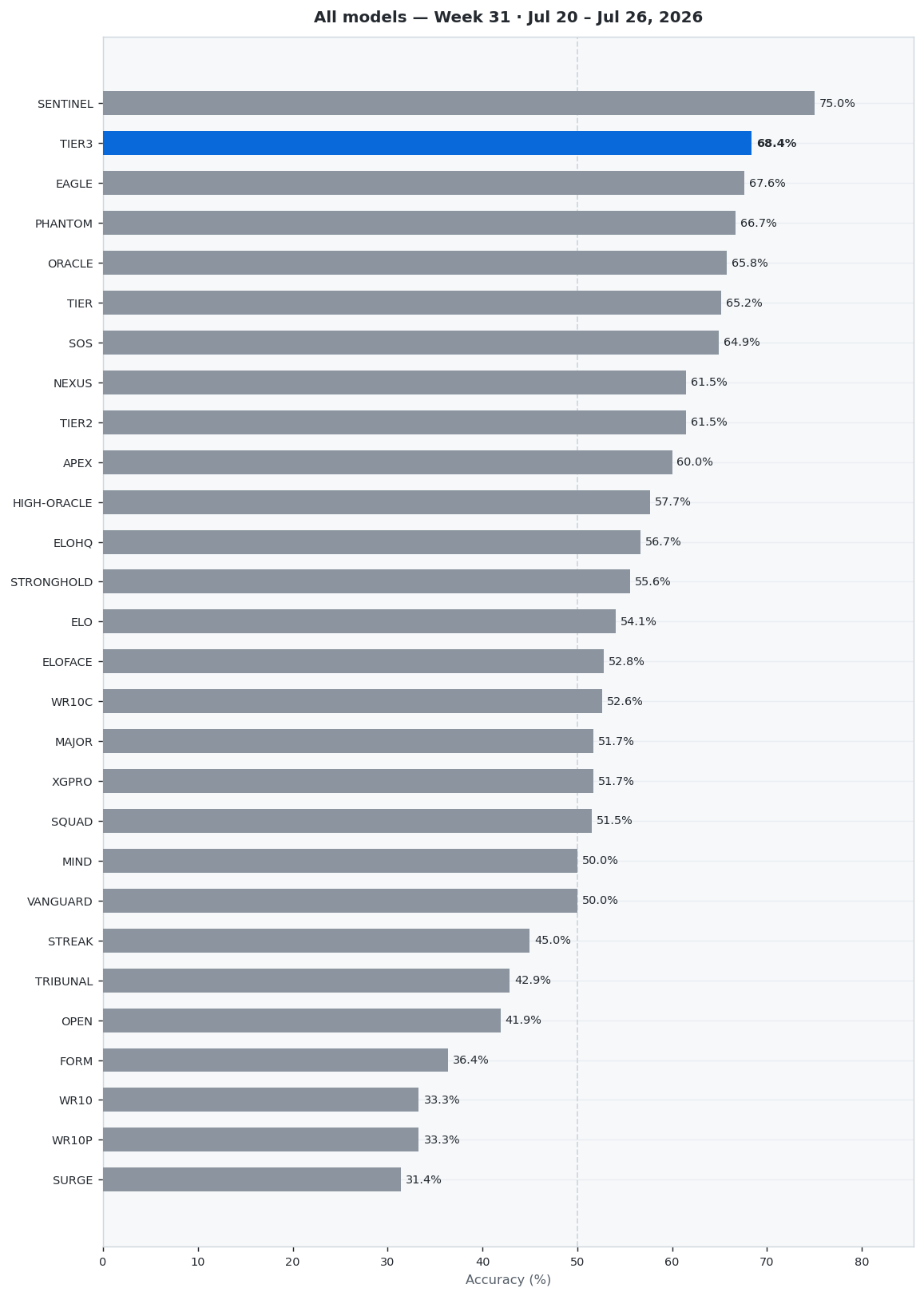
This week (Week 31 · Jul 20 – Jul 26, 2026) we analyzed 41 top-tier CS2 matches across 28 prediction models. TIER3 dominated with 68.4% accuracy (13/19 correct), ahead of TIER3 at 68.4%. TIER3 achieved a Brier Score of 0.2398 and Log Loss of 0.6728.
🏆 Model of the Week: TIER3
TIER3 performed strongly this week with solid accuracy across 19 predictions.
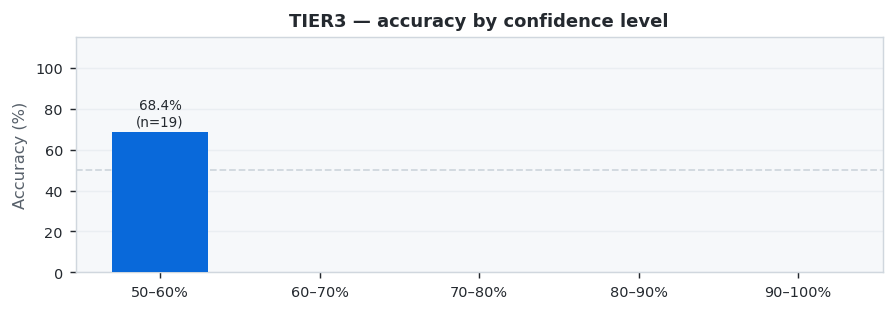
TIER3 showed strong performance with 68.4% accuracy across 19 predictions (13 correct, 6 wrong).
📊 Full Rankings This Week
Complete model performance for the week. The leader is highlighted.
🎮 TIER3 Predictions This Week
13/19 correct predictions on top-tier matches.
| MATCH | PREDICTION | RESULT |
|---|---|---|
| 100 Thieves 1-2 Spirit | 55% Spirit | CORRECT |
| Wildcard 0-2 The MongolZ | 54% The Mongol | CORRECT |
| 3DMAX 2-0 FUT | 53% FUT | WRONG |
| FOKUS 0-2 MOUZ | 54% MOUZ | CORRECT |
| Aurora 2-0 Echo | 54% Aurora | CORRECT |
| Liquid 2-0 G2 | 54% G2 | WRONG |
| DENDELE 2-1 FURIA | 55% FURIA | WRONG |
| Liquid 2-0 Vitality | 57% Vitality | WRONG |
| HEROIC 1-2 The MongolZ | 52% The Mongol | CORRECT |
| SINNERS 1-2 FUT | 54% FUT | CORRECT |
| FOKUS 2-1 Aurora | 54% Aurora | WRONG |
| OG 1-2 Spirit | 57% Spirit | CORRECT |
| 100 Thieves 2-1 Falcons | 55% Falcons | WRONG |
| Aurora 2-1 Nemesis | 54% Aurora | CORRECT |
| Nemiga 1-2 G2 | 54% G2 | CORRECT |
| Aurora 2-1 K27 | 54% Aurora | CORRECT |
| Nemesis 1-2 Astralis | 52% Astralis | CORRECT |
| Nuclear TigeRES 0-2 MOUZ | 54% MOUZ | CORRECT |
| Astralis 2-1 FOKUS | 52% Astralis | CORRECT |
Weekly leaderboard · Week 30 results (Jul 20 – Jul 26, 2026) · published Week 31
🎁 Weekly Pro Rewards
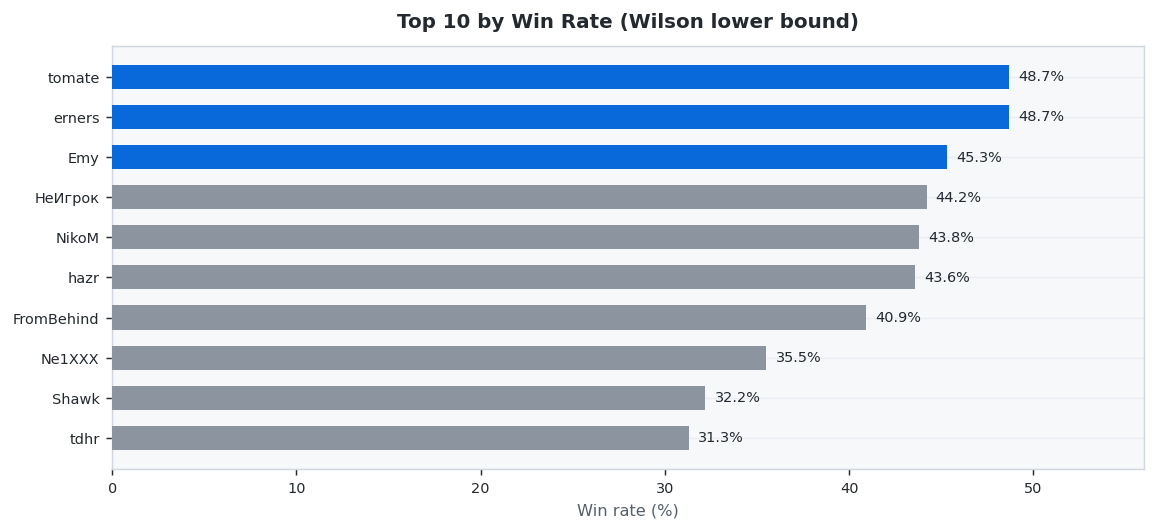
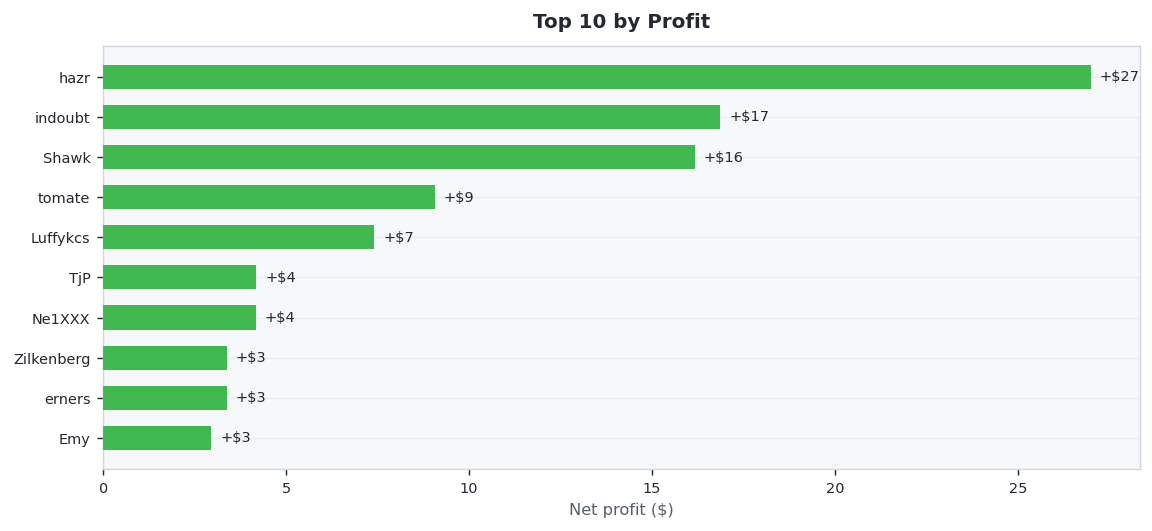
78 predictors placed 568 settled wagers this week (Week 30 results (Jul 20 – Jul 26, 2026) · published Week 31). tomate led on accuracy at 48.7% Wilson, while hazr netted +$26.99 in profit. Average accuracy across the field: 19.7%.
🎯 Win Rate Champion
Highest accuracy by Wilson lower bound (3+ settled wagers required to qualify).
💵 Profit Champion
Highest net USD return (winnings minus stakes). Green bars are winners, red are net losers.
Want next week's prize?
Top-1 in each category wins 1 month Pro. Place 3+ predictions on the match list · check the live leaderboard.
Service notice · July 20–22, 2026
Between 20 July, 23:37 UTC and 22 July, 10:01 UTC (about 34 hours), CS2PREDICT was unavailable due to unplanned technical work on our hosting provider's side. We're sorry for the disruption.
What happened
The outage was entirely on the infrastructure provider — not an issue with your accounts or the platform itself. While the site was down, live predictions and result updates were paused.
Your data and balances are safe
- Balances untouched — no funds were affected in any way.
- All predictions settled correctly — every prediction open during the outage has been reconciled against the real match results and settled. Nothing was left hanging.
- Predictions are back — model predictions for upcoming matches are fully restored and up to date.
A very small number of lower-tier matches that both started and finished during the outage are missing from our match history. They had no effect on predictions, standings, or balances.
What's next: a more powerful server
To prevent this kind of interruption, we're migrating CS2PREDICT to a more powerful server with a new hosting provider. It gives us more headroom and stronger reliability as the platform grows. We'll run the migration during a low-traffic window and announce the exact time in advance, so you'll know when to expect a short, planned maintenance break.
Thanks for your patience — and for predicting with us.
Weekly leaderboard · Week 29 results (Jul 13 – Jul 19, 2026) · published Week 30
🎁 Weekly Pro Rewards
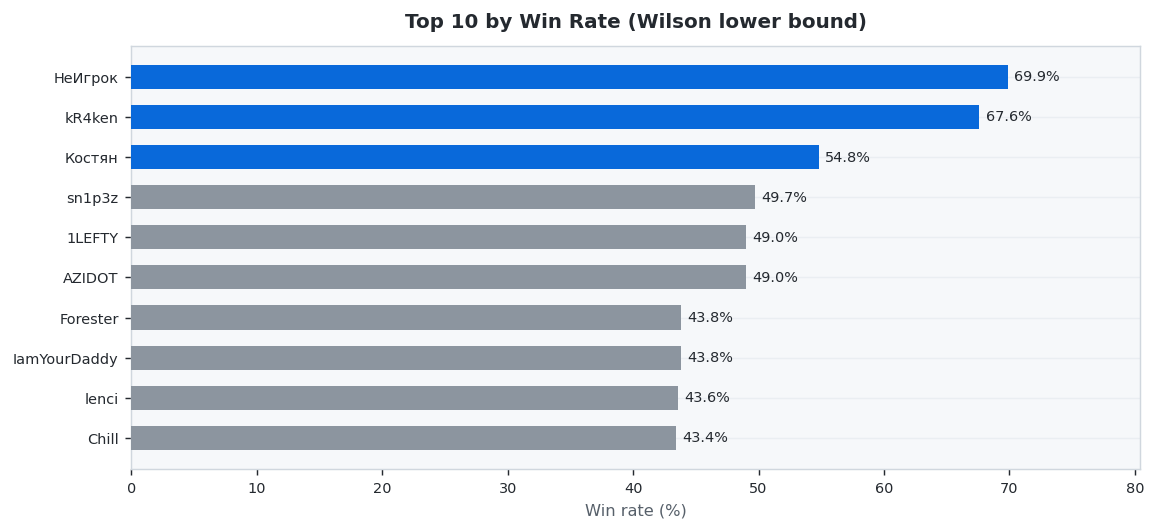
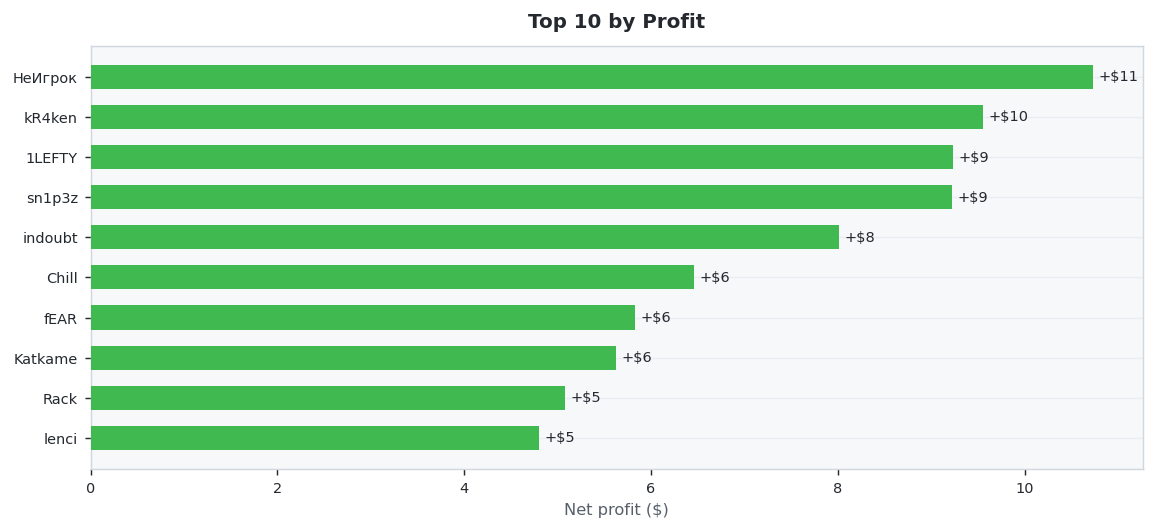
85 predictors placed 595 settled wagers this week (Week 29 results (Jul 13 – Jul 19, 2026) · published Week 30). НеИгрок led on accuracy at 69.9% Wilson, while НеИгрок netted +$10.73 in profit. Average accuracy across the field: 19.9%.
🎯 Win Rate Champion
Highest accuracy by Wilson lower bound (3+ settled wagers required to qualify).
💵 Profit Champion
Highest net USD return (winnings minus stakes). Green bars are winners, red are net losers.
Want next week's prize?
Top-1 in each category wins 1 month Pro. Place 3+ predictions on the match list · check the live leaderboard.
Weekly digest · Top-tier CS2 matches · Week 30 · Jul 13 – Jul 19, 2026
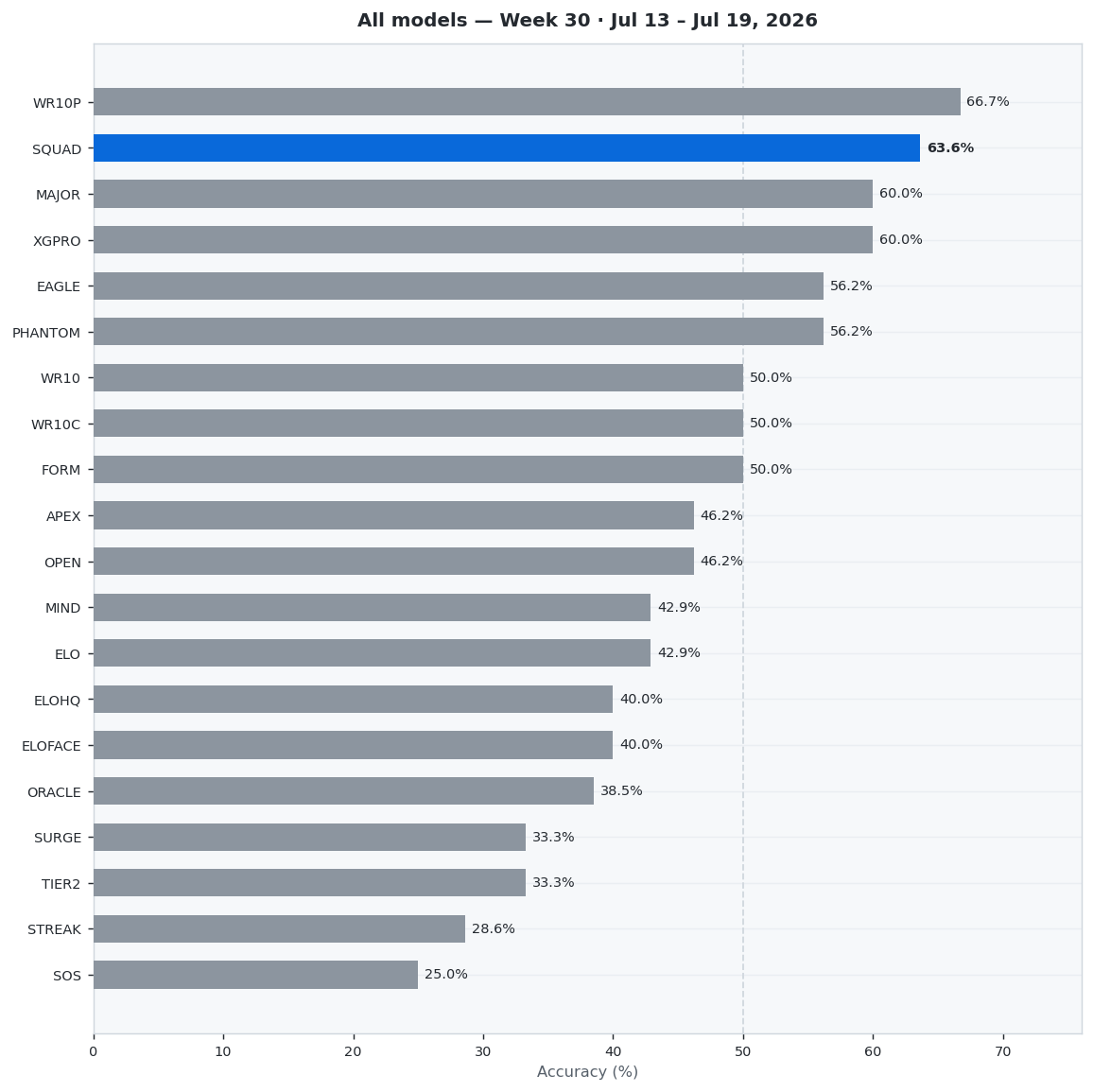
This week (Week 30 · Jul 13 – Jul 19, 2026) we analyzed 20 top-tier CS2 matches across 20 prediction models. SQUAD dominated with 63.6% accuracy (7/11 correct), ahead of SQUAD at 63.6%. SQUAD achieved a Brier Score of 0.2753 and Log Loss of 0.7836.
🏆 Model of the Week: SQUAD
SQUAD edged out the competition this week, though accuracy across all models was moderate.
SQUAD showed decent performance with 63.6% accuracy across 11 predictions (7 correct, 4 wrong).
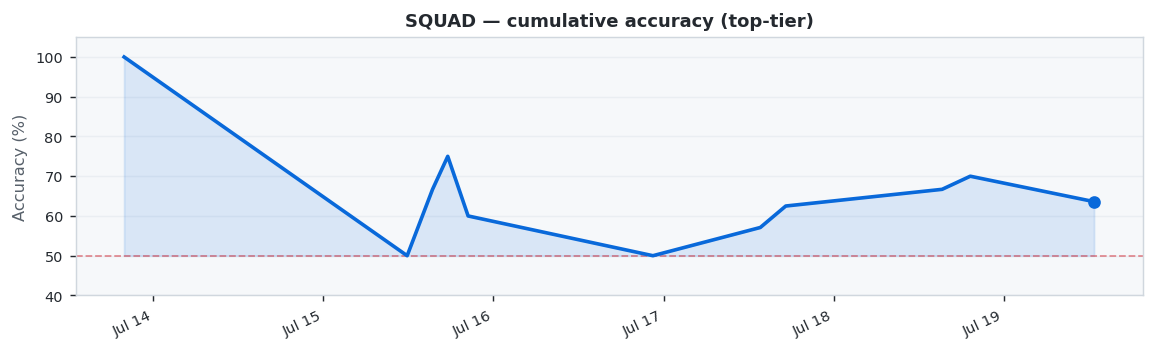
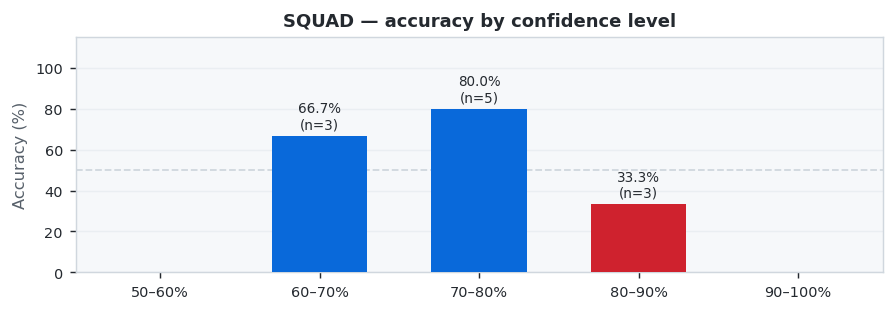
📊 Full Rankings This Week
Complete model performance for the week. The leader is highlighted.
🎮 SQUAD Predictions This Week
7/11 correct predictions on top-tier matches.
| MATCH | PREDICTION | RESULT |
|---|---|---|
| United Kingdom 2-0 Belgium | 86% Belgium | WRONG |
| HEROIC 3-0 K27 | 61% HEROIC | CORRECT |
| Ninjas in Pyjamas 1-2 K27 | 72% K27 | CORRECT |
| Ninjas in Pyjamas 1-2 HEROIC | 80% HEROIC | CORRECT |
| K27 2-0 Phantom | 87% K27 | CORRECT |
| Imperial 1-2 Fluxo | 69% Imperial | WRONG |
| paiN 1-2 Phantom | 87% paiN | WRONG |
| Wildcard 0-2 Gentle Mates | 78% Gentle Mat | CORRECT |
| 3DMAX 1-2 HEROIC | 61% HEROIC | CORRECT |
| Ninjas in Pyjamas 2-0 K27 | 72% K27 | WRONG |
| fnatic 2-0 SPARTA | 77% fnatic | CORRECT |
Weekly digest · Top-tier CS2 matches · Week 29 · Jul 06 – Jul 12, 2026
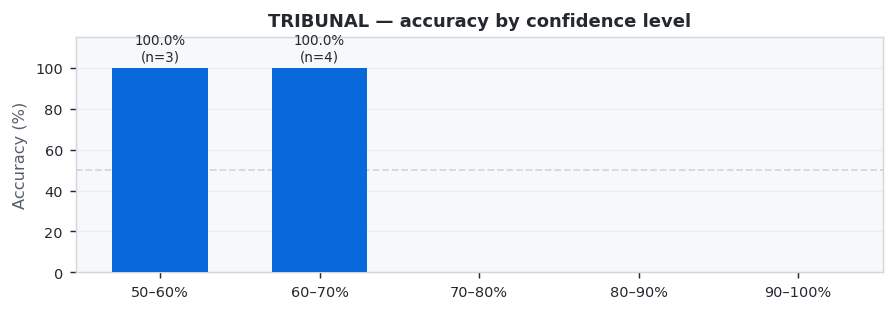
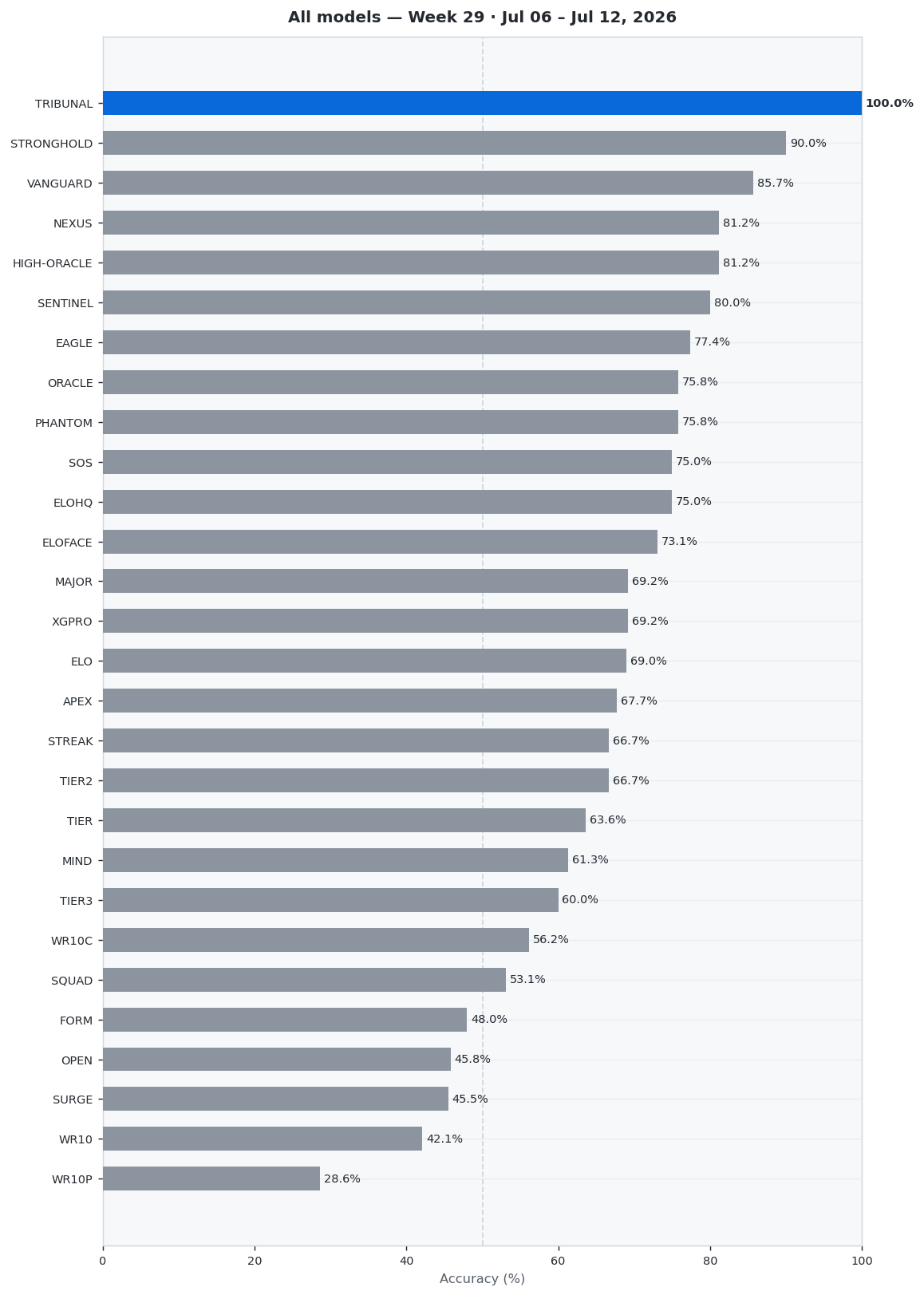
This week (Week 29 · Jul 06 – Jul 12, 2026) we analyzed 35 top-tier CS2 matches across 28 prediction models. TRIBUNAL dominated with 100.0% accuracy (7/7 correct), ahead of STRONGHOLD at 90.0%. TRIBUNAL achieved a Brier Score of 0.1544 and Log Loss of 0.4987.
🏆 Model of the Week: TRIBUNAL
TRIBUNAL had an outstanding week, correctly predicting 7 out of 7 matches.
TRIBUNAL showed excellent performance with 100.0% accuracy across 7 predictions (7 correct, 0 wrong).
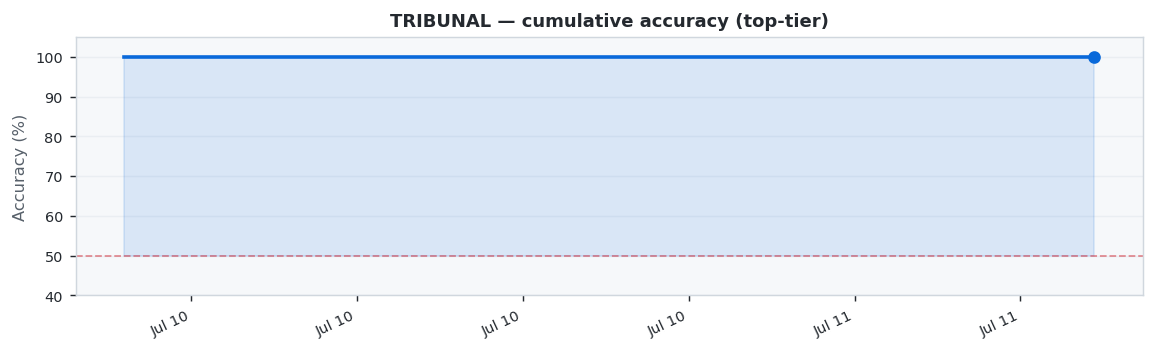
📊 Full Rankings This Week
Complete model performance for the week. The leader is highlighted.
🎮 TRIBUNAL Predictions This Week
7/7 correct predictions on top-tier matches.
| MATCH | PREDICTION | RESULT |
|---|---|---|
| The Huns 0-2 TYLOO | 62% TYLOO | CORRECT |
| M80 2-0 LAG | 63% M80 | CORRECT |
| 5star 2-1 Alter Ego | 58% 5star | CORRECT |
| TYLOO 2-0 The MongolZ Academy | 63% TYLOO | CORRECT |
| BESTIA 2-0 Fluxo | 59% BESTIA | CORRECT |
| Voca 2-0 NuTorious | 58% Voca | CORRECT |
| magic 2-1 EAC | 64% magic | CORRECT |
Weekly leaderboard · Week 28 results (Jul 06 – Jul 12, 2026) · published Week 29
🎁 Weekly Pro Rewards
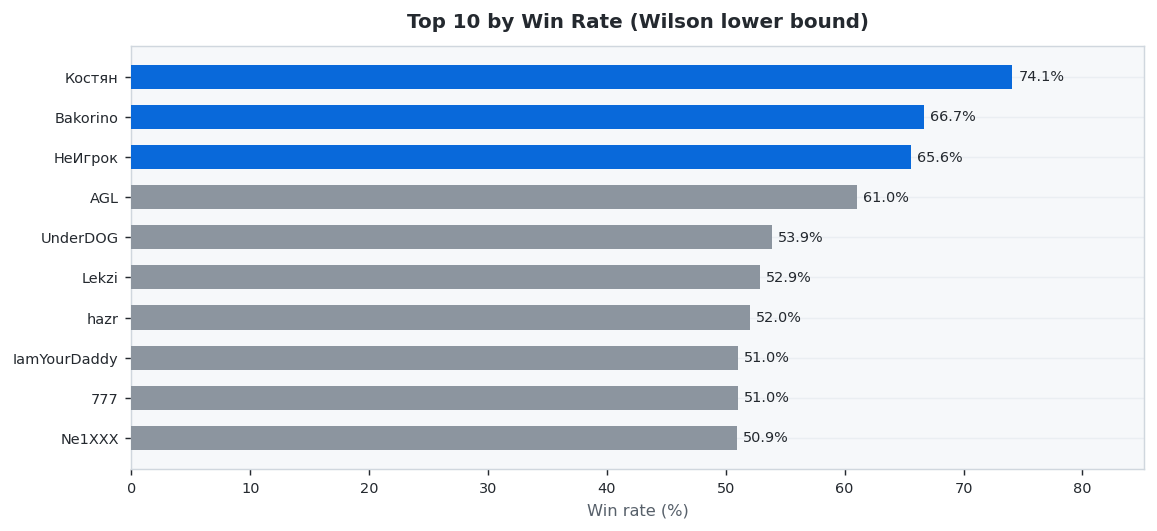
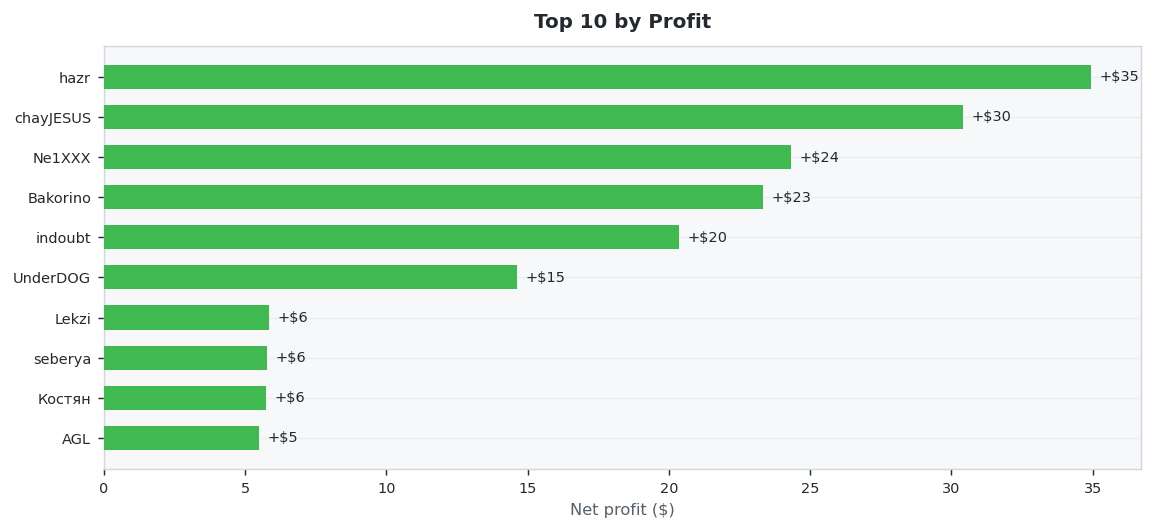
93 predictors placed 837 settled wagers this week (Week 28 results (Jul 06 – Jul 12, 2026) · published Week 29). Костян led on accuracy at 74.1% Wilson, while hazr netted +$34.96 in profit. Average accuracy across the field: 23.0%.
🎯 Win Rate Champion
Highest accuracy by Wilson lower bound (3+ settled wagers required to qualify).
💵 Profit Champion
Highest net USD return (winnings minus stakes). Green bars are winners, red are net losers.
Want next week's prize?
Top-1 in each category wins 1 month Pro. Place 3+ predictions on the match list · check the live leaderboard.
Weekly leaderboard · Week 27 results (Jun 29 – Jul 05, 2026) · published Week 28
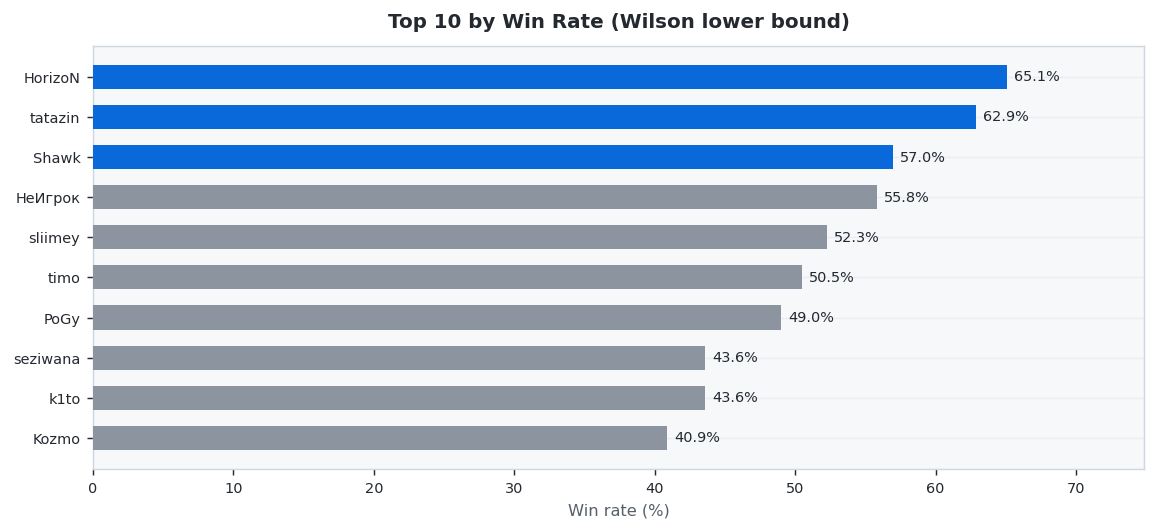
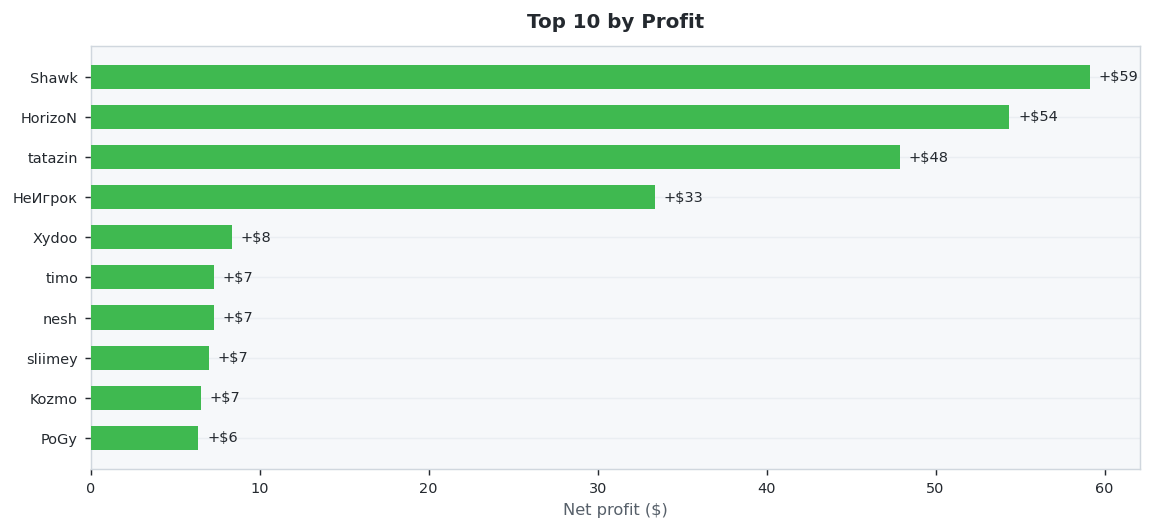
92 predictors placed 994 settled wagers this week (Week 27 results (Jun 29 – Jul 05, 2026) · published Week 28). HorizoN led on accuracy at 65.1% Wilson, while Shawk netted +$59.13 in profit. Average accuracy across the field: 23.3%.
🎯 Win Rate Champion
Highest accuracy by Wilson lower bound (3+ settled wagers required to qualify).
💵 Profit Champion
Highest net USD return (winnings minus stakes). Green bars are winners, red are net losers.
Want next week's prize?
Top-1 in each category wins +$20. Place 3+ predictions on the match list · check the live leaderboard.
Weekly digest · Top-tier CS2 matches · Week 28 · Jun 29 – Jul 05, 2026
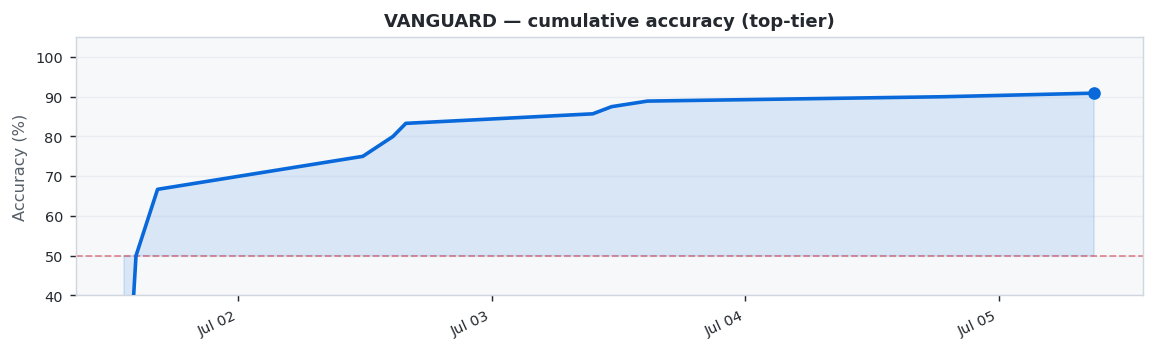
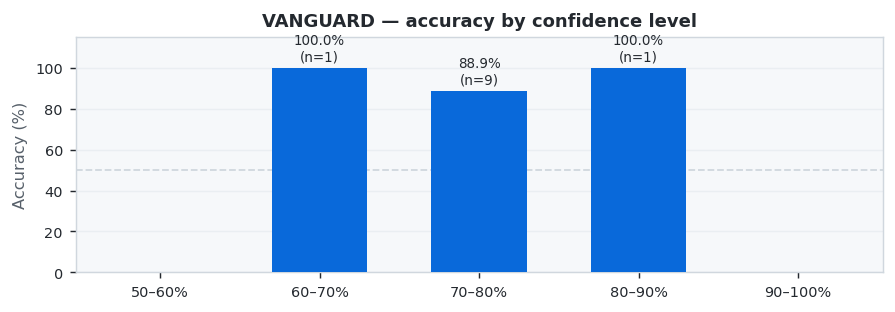
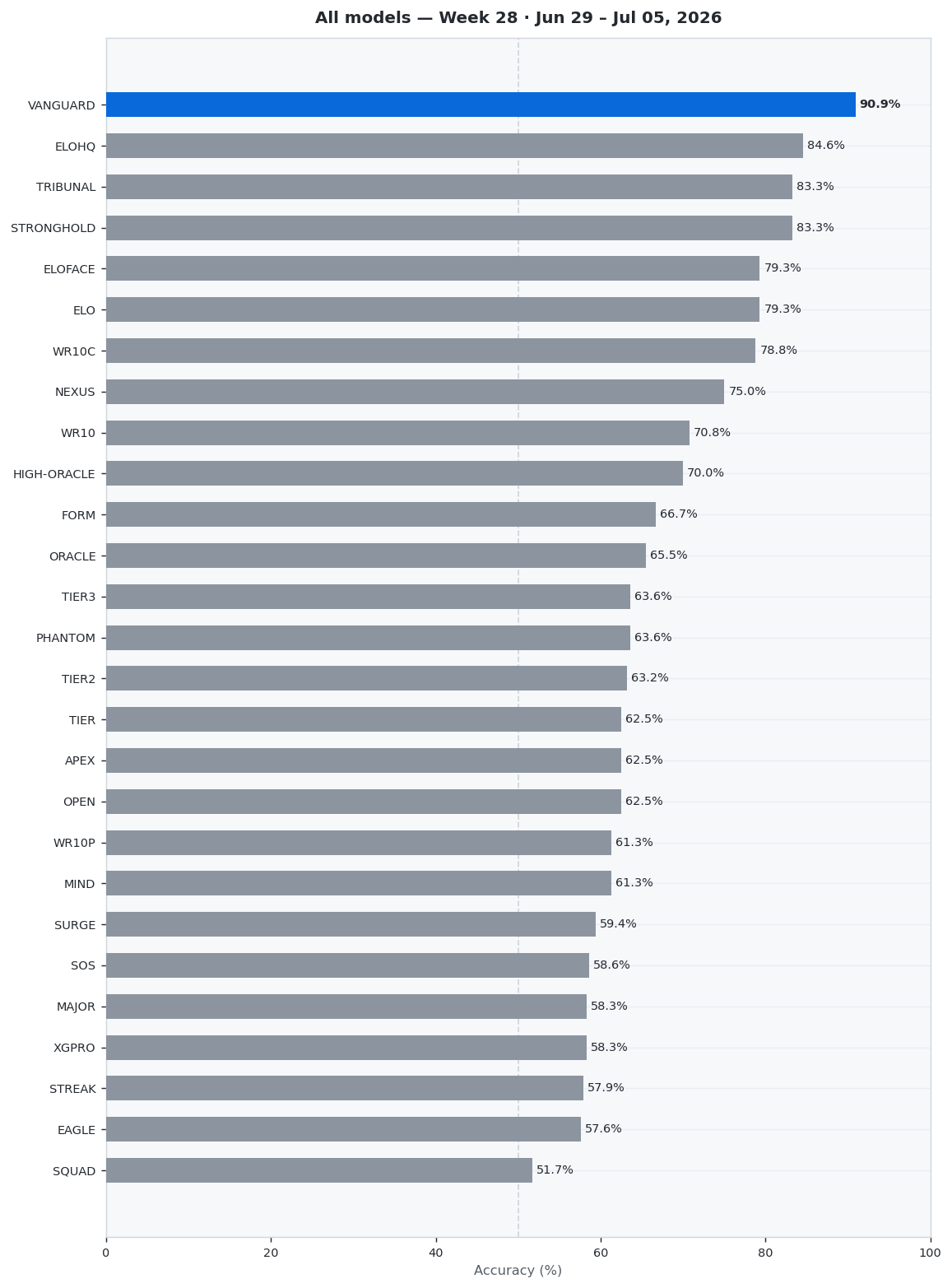
This week (Week 28 · Jun 29 – Jul 05, 2026) we analyzed 34 top-tier CS2 matches across 27 prediction models. VANGUARD dominated with 90.9% accuracy (10/11 correct), ahead of ELOHQ at 84.6%. VANGUARD achieved a Brier Score of 0.1065 and Log Loss of 0.3789.
🏆 Model of the Week: VANGUARD
VANGUARD had an outstanding week, correctly predicting 10 out of 11 matches.
VANGUARD showed excellent performance with 90.9% accuracy across 11 predictions (10 correct, 1 wrong).
📊 Full Rankings This Week
Complete model performance for the week. The leader is highlighted.
🎮 VANGUARD Predictions This Week
10/11 correct predictions on top-tier matches.
| MATCH | PREDICTION | RESULT |
|---|---|---|
| MIBR 0-2 9z | 74% 9z | CORRECT |
| EYEBALLERS 1-2 Nemesis | 74% Nemesis | CORRECT |
| FaZe 2-0 SINNERS | 66% FaZe | CORRECT |
| 3DMAX 9-13 9z | 79% 9z | CORRECT |
| Luminosity 1-2 Ninjas in Pyjamas | 77% Ninjas in | CORRECT |
| 9z 13-5 SINNERS | 79% 9z | CORRECT |
| BetBoom 13-11 BIG | 72% BetBoom | CORRECT |
| Luminosity 8-13 Lynn Vision | 78% Lynn Visio | CORRECT |
| BetBoom 13-4 SINNERS | 78% BetBoom | CORRECT |
| Luminosity 10-13 Nemesis | 87% Nemesis | CORRECT |
| 9z 10-13 EYEBALLERS | 76% 9z | WRONG |
Monthly digest · Top-tier CS2 matches · July 2026
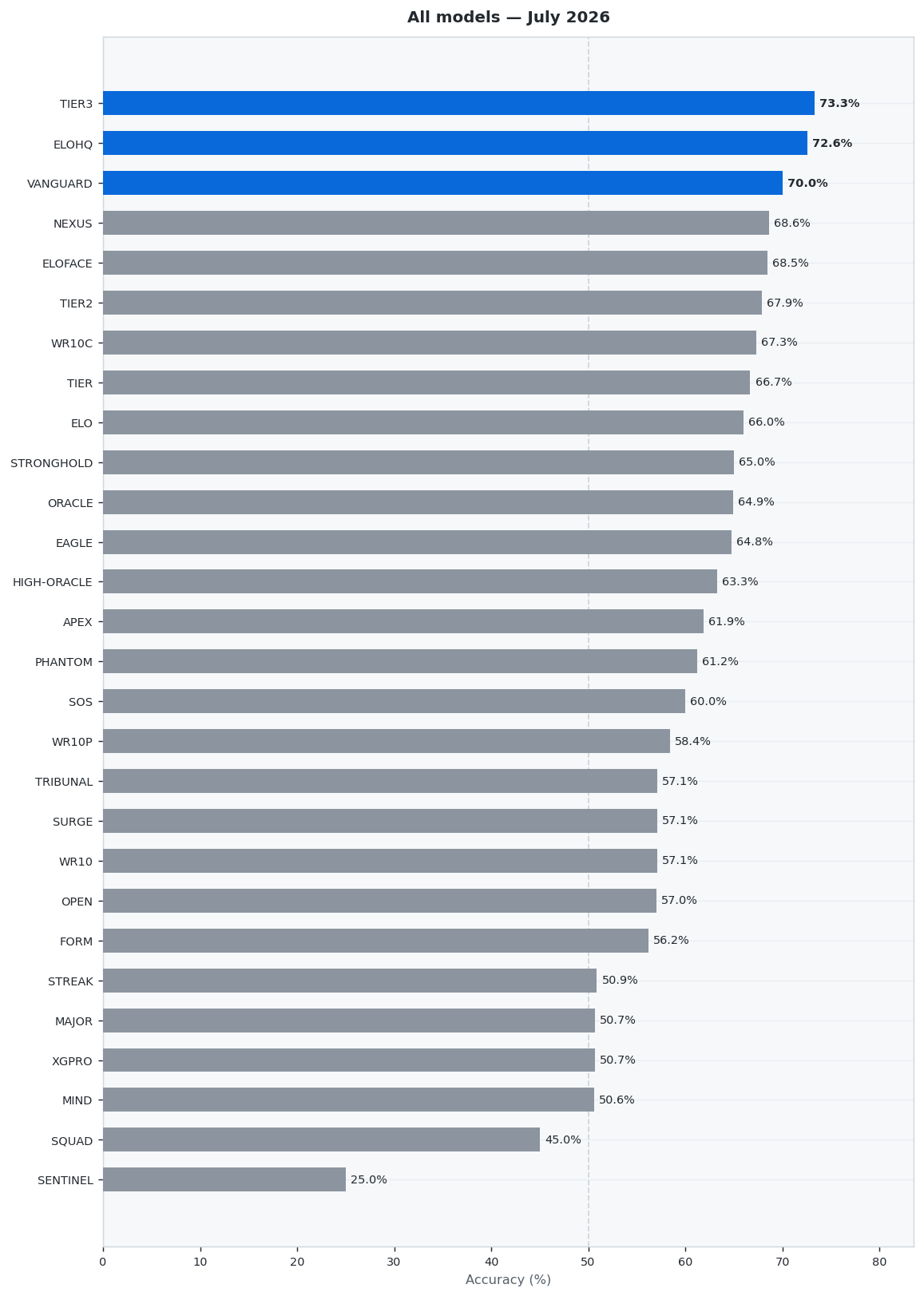
Based on June 2026 data, we tracked 115 top-tier CS2 matches across 28 prediction models with a total of 1926 predictions. The average model accuracy was 59.9%, with a spread of 48.3% between the best and worst performing models.
🏆 Top 3 Models of the Month
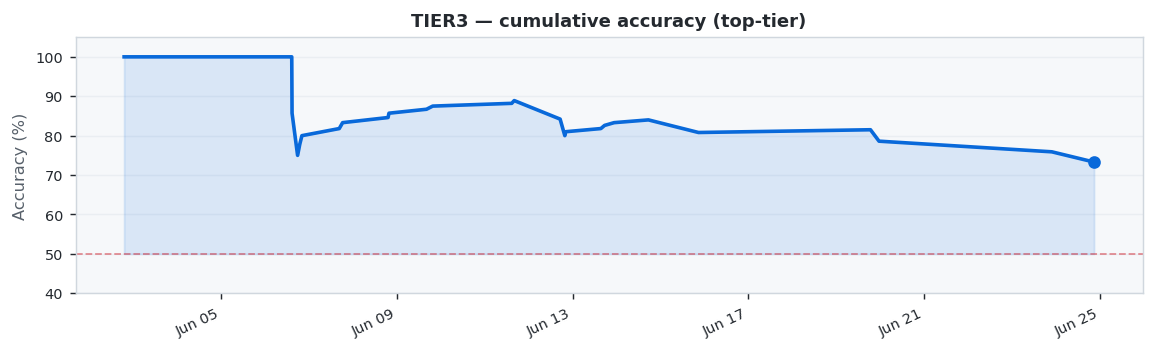
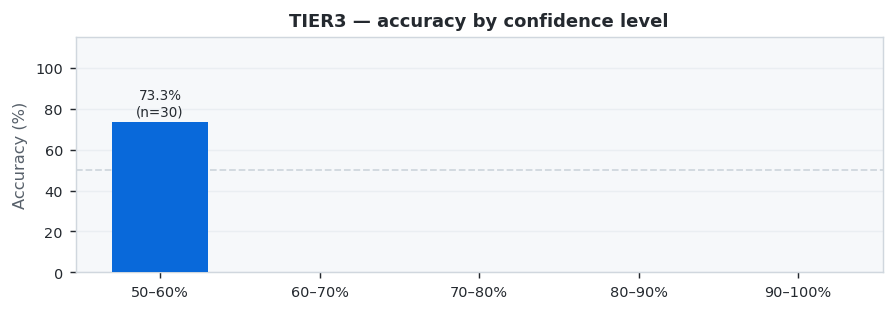
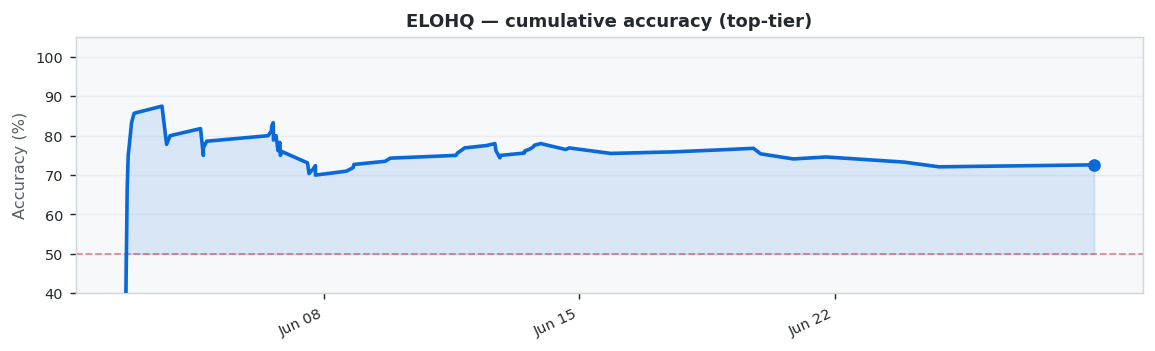
TIER3 takes the top spot with 73.3% accuracy, followed by ELOHQ at 72.6% and VANGUARD at 70.0%.
TIER3 showed strong performance with 73.3% accuracy across 30 predictions (22 correct, 8 wrong). Best week: W24 at 84.6%, weakest: W26 at 0.0%.
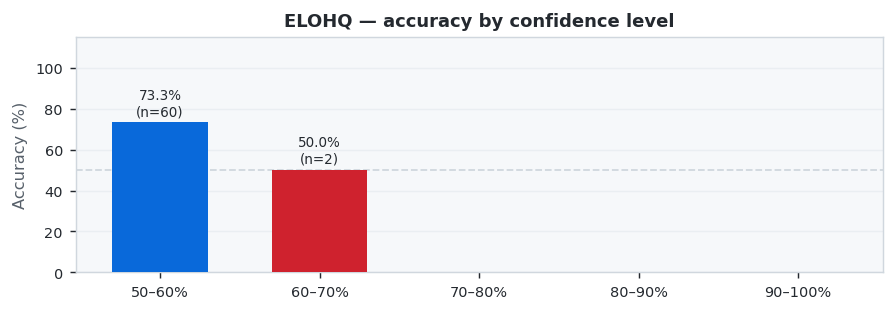
ELOHQ showed strong performance with 72.6% accuracy across 62 predictions (45 correct, 17 wrong). Best week: W27 at 100.0%, weakest: W26 at 0.0%.
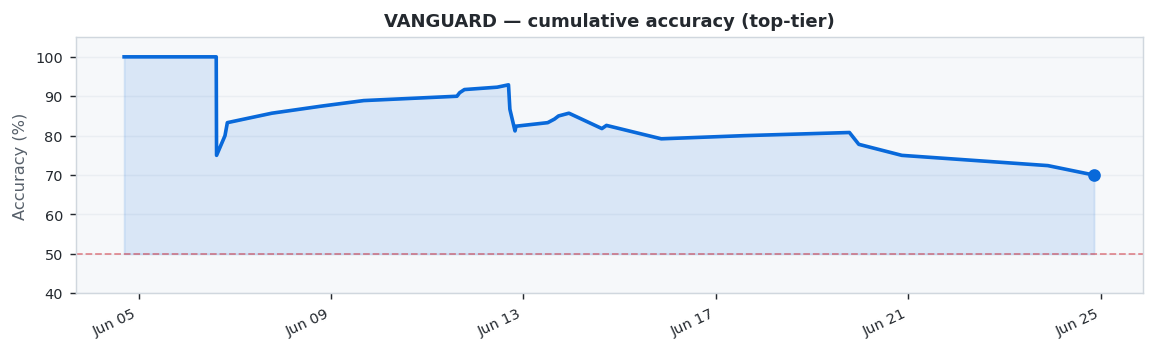
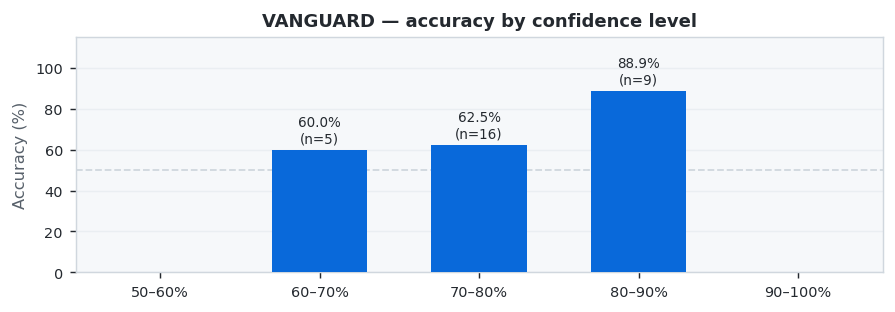
VANGUARD showed strong performance with 70.0% accuracy across 30 predictions (21 correct, 9 wrong). Best week: W23 at 85.7%, weakest: W26 at 0.0%.
📊 Full Monthly Leaderboard
Below is the complete ranking of all models. Models highlighted in blue are in the top 3. The bar chart shows relative performance at a glance.
Monthly leaderboard · June 2026 results · published July 2026
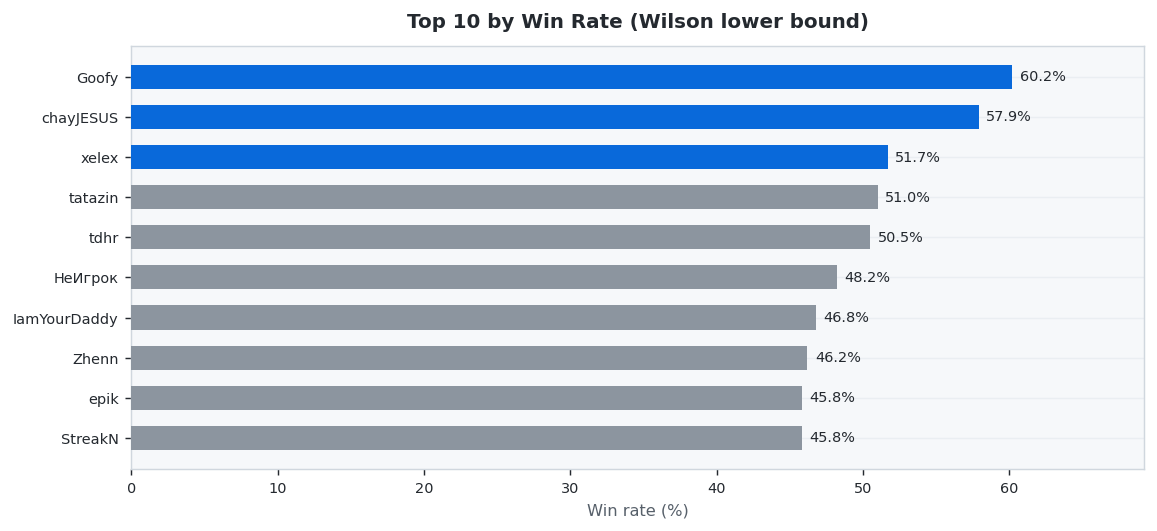
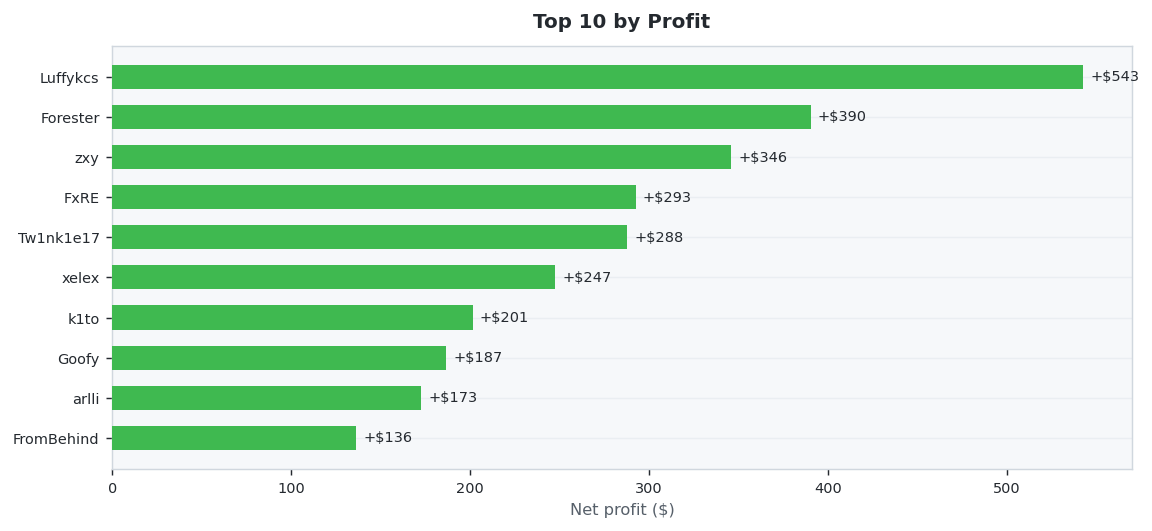
92 predictors placed 2215 settled wagers this month (June 2026 results · published July 2026). Goofy led on accuracy at 60.2% Wilson, while Luffykcs netted +$542.88 in profit. Average accuracy across the field: 30.0%.
🎯 Win Rate Champion
Highest accuracy by Wilson lower bound (3+ settled wagers required to qualify).
💵 Profit Champion
Highest net USD return (winnings minus stakes). Green bars are winners, red are net losers.
Want next month's prize?
Top-1 in each category wins +$50. Place 3+ predictions on the match list · check the live leaderboard.
To simplify pricing and based on your feedback, we're consolidating our subscriptions down to a single Pro tier. Effective July 1, 2026:
What's changing
- Basic tier retires. The Basic plan will no longer be offered as of July 1.
- All Basic-tier models move to Pro. Models that used to require Basic are now included in Pro — same access, no gaps.
- Current Basic subscribers get free Pro through the end of their existing billing period. No action needed — the upgrade is applied automatically. When your current period ends, you can choose whether to continue with Pro.
- Pro price drops $5: monthly goes from $20 to $15/mo, annual goes from $200 to $150/yr (still the same ~17% savings vs monthly).
Why we're doing this
A two-tier setup added decision friction without delivering proportional value: most users on Basic eventually upgraded to Pro for the model access anyway, and the “am I missing something on the next tier?” question kept coming up in support tickets.
One clear plan, lower price, every model included — that's the shape that matches how you actually use the site.
What stays the same
- All your existing model histories, predictions, achievements, balance, and leaderboard standing.
- Free tier remains: browse, view predictions, see leaderboards, read blog — without an account or a paid plan.
- Pari-mutuel prediction pools remain Pro-only (5% commission, winners split losers' pool — same mechanic).
Timeline
- Now → June 30: Basic and Pro both available at current prices.
- July 1: Basic is removed from signup. Existing Basic subscribers are upgraded to Pro for free until their billing period ends. New Pro signups at $15/mo or $150/yr.
- After your Basic period ends: Auto-renew (if enabled) will renew you to Pro at $15/mo. You can change or cancel anytime from your subscription page.
Questions? Drop a ticket from Support. We'll keep this post updated with any clarifications.
— The cs2predict team