Blog
News, updates and analysis
Not much to report this week — the calendar landed between events. From June 22 through 28 only two matches on the top / major tier reached completion, which is far short of what we normally need for a meaningful model breakdown.
Why the "Model of the Week" isn't ranked this time
Our weekly digest normally ranks all 20+ models by accuracy across the week's premium matches. With just 2 matches:
- Every model sits at either 0%, 50%, or 100% accuracy — a coin-flip statistic, not signal.
- The "winner" would be whichever model happened to call one specific match correctly. That's noise dressed up as insight.
- Publishing rankings on this small a sample would mislead more than inform.
So instead of pretending, here's the actual state.
What ran during the week
- EPL World SEA S16 wrapped up — regional finals came in mid-week; most matches sat in tier=professional or tier=other, not top-tier by our classifier.
- Assorted qualifiers (TI-EU CQ, TI-NA CQ, CCT Series, Choco Cup) — most of the week's traffic, but again below the "major" bar we use for the digest.
- The 2 top-tier matches that did settle were isolated one-offs at the edges of the week.
Coming up
The calendar picks up sharply from here — TI2026 Regional Qualifiers are still active, and higher-tier lineups roll into July. Model accuracy stats will start being meaningful again as soon as those matches settle. Watch the Models page for live leaderboard positioning, and the Matches feed for what's scheduled.
A note on our methodology: we intentionally hold the "Model of the Week" post to at least 3 predictions per model. If we can't clear that bar, we say so instead of publishing noisy rankings. Full model accuracy across all time windows is always available on the Models leaderboard.
— The cs2predict team
Weekly leaderboard · Week 26 results (Jun 22 – Jun 28, 2026) · published Week 27
💰 Weekly Cash Prizes
57 predictors placed 640 settled wagers this week (Week 26 results (Jun 22 – Jun 28, 2026) · published Week 27). chayJESUS led on accuracy at 60.0% Wilson, while chayJESUS netted +$16.16 in profit. Average accuracy across the field: 25.1%.
🎯 Win Rate Champion
Highest accuracy by Wilson lower bound (3+ settled wagers required to qualify).
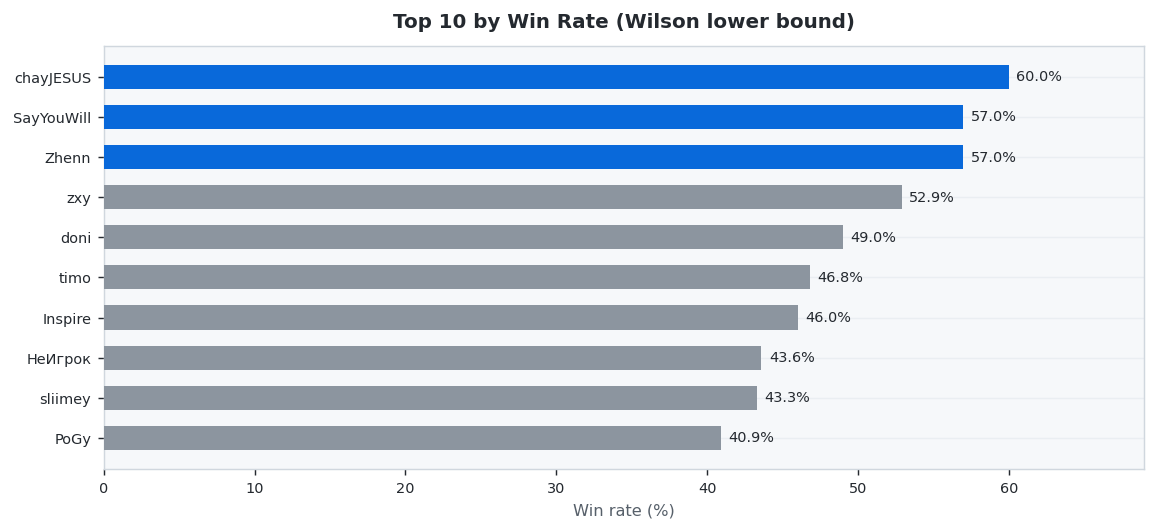
- 🥇 chayJESUS — 60.0% Wilson (17W / 4L)
- 🥈 SayYouWill — 57.0% Wilson (13W / 3L)
- 🥉 Zhenn — 57.0% Wilson (13W / 3L)
💵 Profit Champion
Highest net USD return (winnings minus stakes). Green bars are winners, red are net losers.
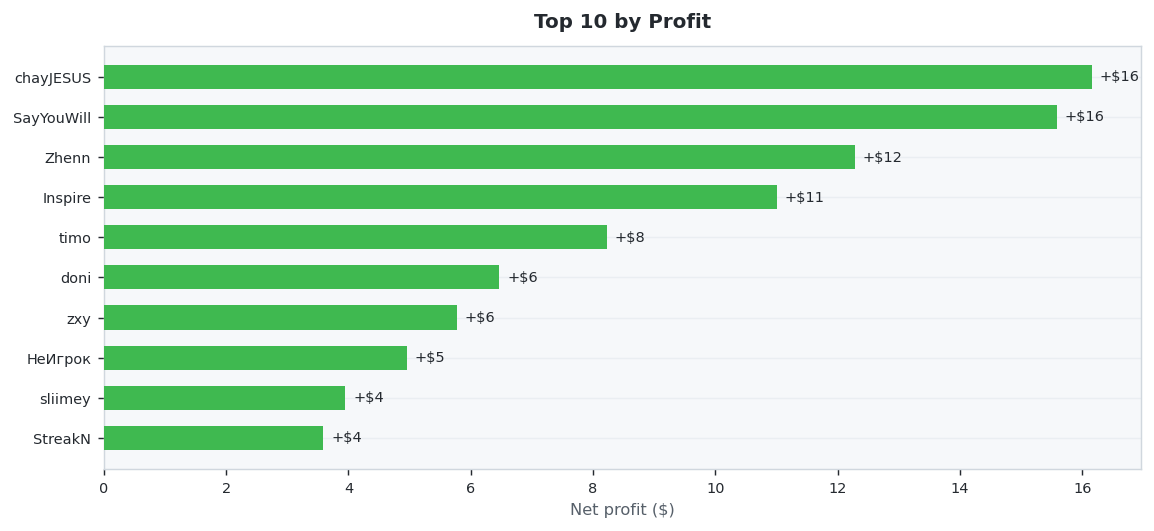
- 🥇 chayJESUS — +$16.16 (21 bets)
- 🥈 SayYouWill — +$15.59 (16 bets)
- 🥉 Zhenn — +$12.28 (16 bets)
Want next week's prize?
Top-1 in each category wins +$20. Place 3+ predictions on the match list · check the live leaderboard.
Weekly digest · Top-tier CS2 matches · Week 26 · Jun 15 – Jun 21, 2026
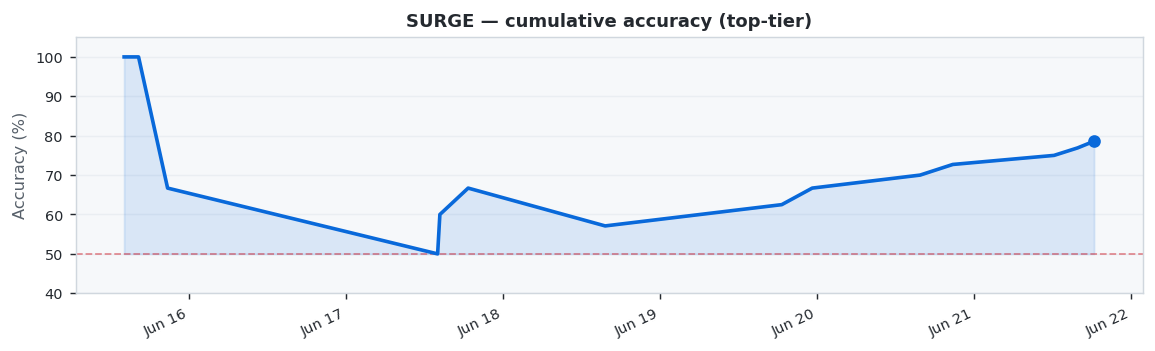
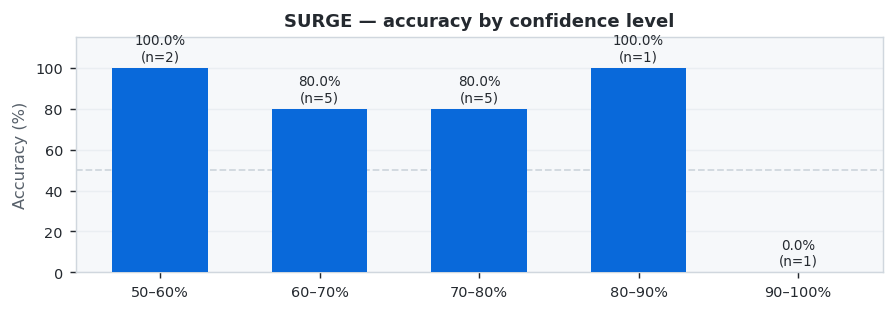
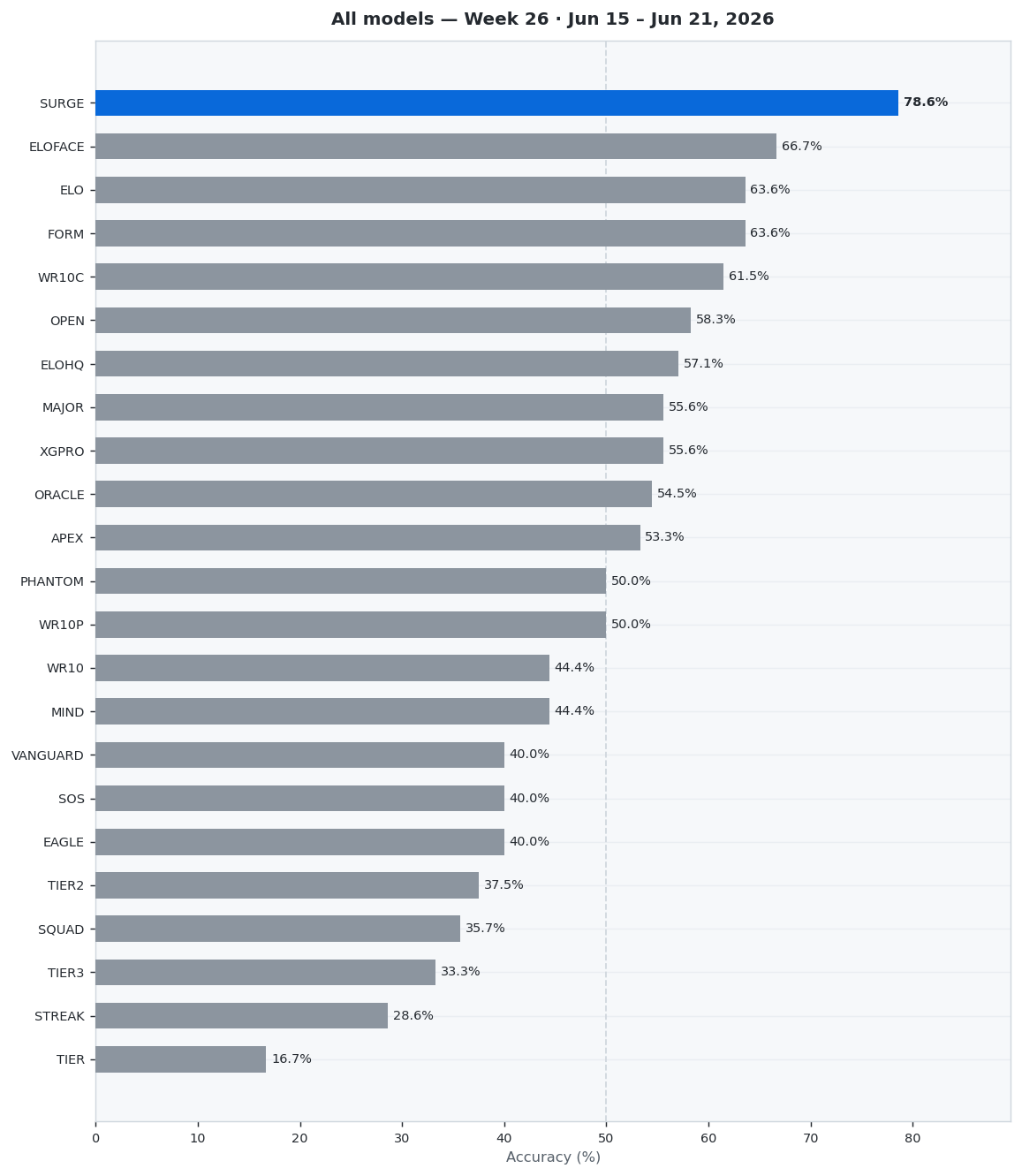
This week (Week 26 · Jun 15 – Jun 21, 2026) we analyzed 16 top-tier CS2 matches across 23 prediction models. SURGE dominated with 78.6% accuracy (11/14 correct), ahead of ELOFACE at 66.7%. SURGE achieved a Brier Score of 0.201 and Log Loss of 0.6194.
🏆 Model of the Week: SURGE
SURGE had an outstanding week, correctly predicting 11 out of 14 matches.
SURGE showed excellent performance with 78.6% accuracy across 14 predictions (11 correct, 3 wrong).
📊 Full Rankings This Week
Complete model performance for the week. The leader is highlighted.
🎮 SURGE Predictions This Week
11/14 correct predictions on top-tier matches.
| MATCH | PREDICTION | RESULT |
|---|---|---|
| FURIA 0-3 Falcons | 79% Falcons | CORRECT |
| TDK 2-0 100 Thieves | 67% TDK | CORRECT |
| Virtus.pro 0-2 ex-RUBY | 67% ex-RUBY | CORRECT |
| Spirit 1-2 Falcons | 76% Falcons | CORRECT |
| Aurora 0-2 FURIA | 73% FURIA | CORRECT |
| Falcons 2-1 Vitality | 83% Falcons | CORRECT |
| G2 1-2 Spirit | 67% Spirit | CORRECT |
| Aurora 2-0 BetBoom | 73% BetBoom | WRONG |
| Nuclear TigeRES 2-1 Nemesis | 53% Nuclear Ti | CORRECT |
| TDK 1-2 Nemesis | 57% Nemesis | CORRECT |
| PsychoFace 1-2 Virtus.pro | 91% PsychoFace | WRONG |
| Natus Vincere 1-2 G2 | 62% Natus Vinc | WRONG |
| BetBoom 2-0 FUT | 77% BetBoom | CORRECT |
| 9z 2-0 The MongolZ | 70% 9z | CORRECT |
Weekly leaderboard · Week 25 results (Jun 15 – Jun 21, 2026) · published Week 26
💰 Weekly Cash Prizes
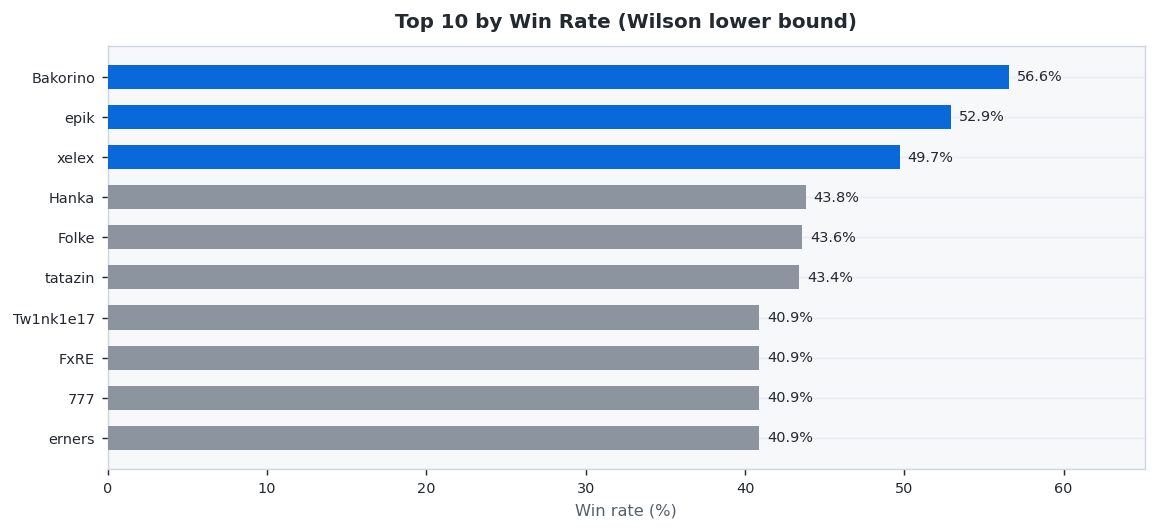
86 predictors placed 505 settled wagers this week (Week 25 results (Jun 15 – Jun 21, 2026) · published Week 26). Bakorino led on accuracy at 56.6% Wilson, while NucleonZ netted +$88.34 in profit. Average accuracy across the field: 20.4%.
🎯 Win Rate Champion
Highest accuracy by Wilson lower bound (3+ settled wagers required to qualify).
💵 Profit Champion
Highest net USD return (winnings minus stakes). Green bars are winners, red are net losers.
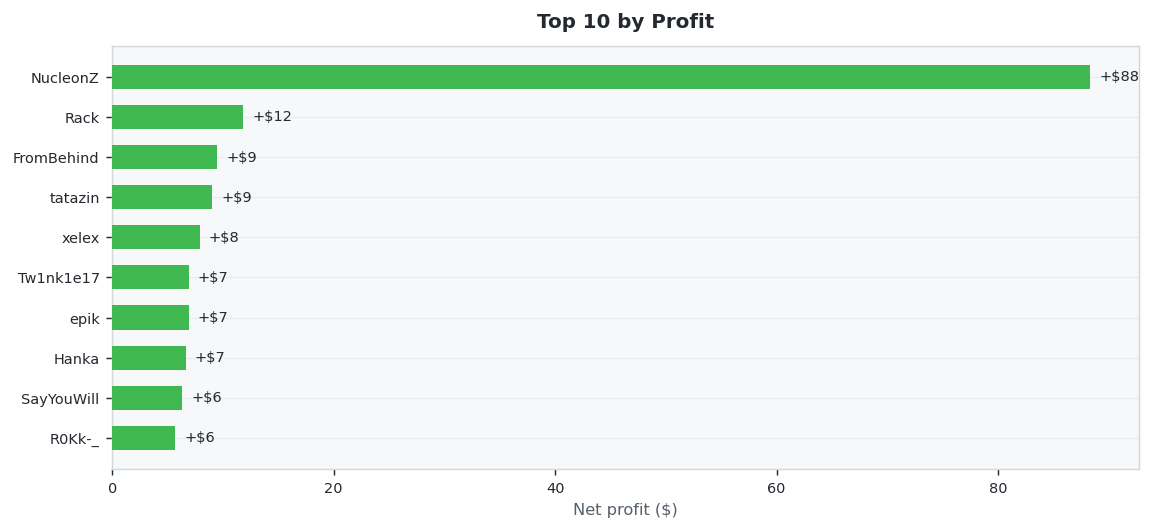
- 🥇 NucleonZ — +$88.34 (8 bets)
- 🥈 Rack — +$11.82 (11 bets)
- 🥉 FromBehind — +$9.48 (6 bets)
Want next week's prize?
Top-1 in each category wins +$20. Place 3+ predictions on the match list · check the live leaderboard.
Weekly leaderboard · Week 24 results (Jun 08 – Jun 14, 2026) · published Week 25
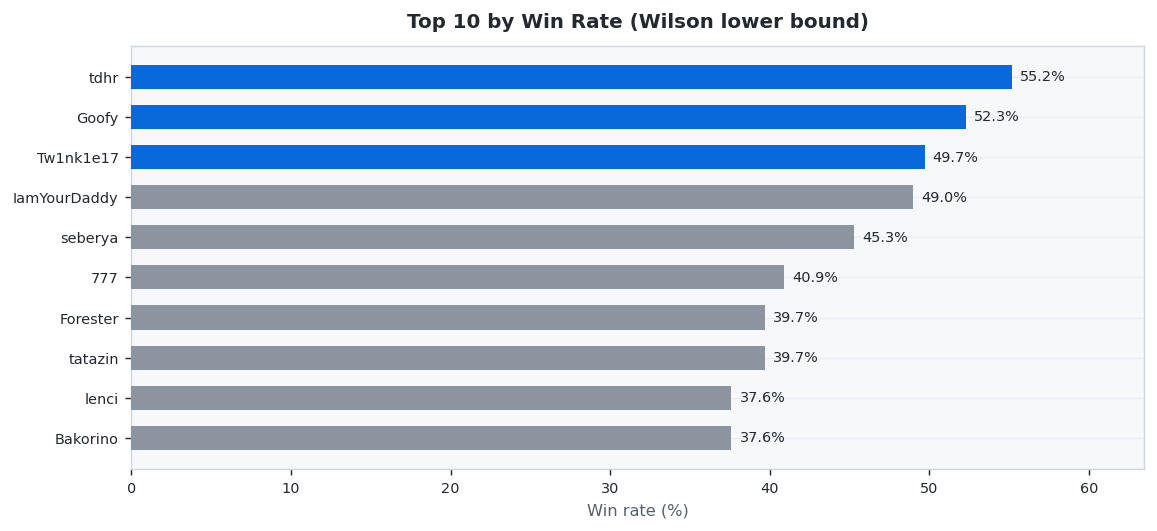
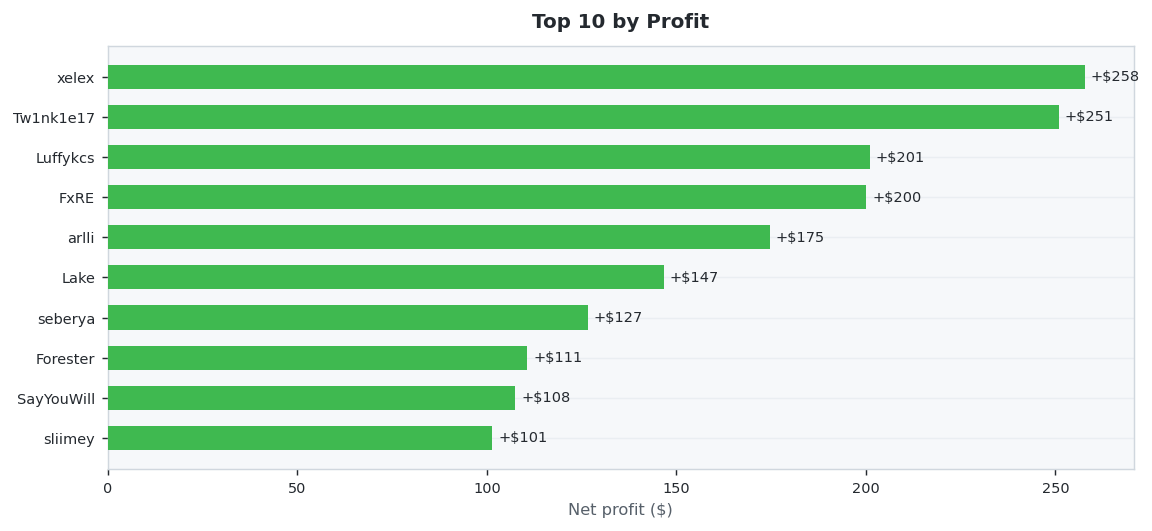
50 predictors placed 428 settled wagers this week (Week 24 results (Jun 08 – Jun 14, 2026) · published Week 25). tdhr led on accuracy at 55.2% Wilson, while xelex netted +$257.77 in profit. Average accuracy across the field: 25.3%.
🎯 Win Rate Champion
Highest accuracy by Wilson lower bound (3+ settled wagers required to qualify).
💵 Profit Champion
Highest net USD return (winnings minus stakes). Green bars are winners, red are net losers.
Want next week's prize?
Top-1 in each category wins +$20. Place 3+ predictions on the match list · check the live leaderboard.
Weekly digest · Top-tier CS2 matches · Week 25 · Jun 08 – Jun 14, 2026
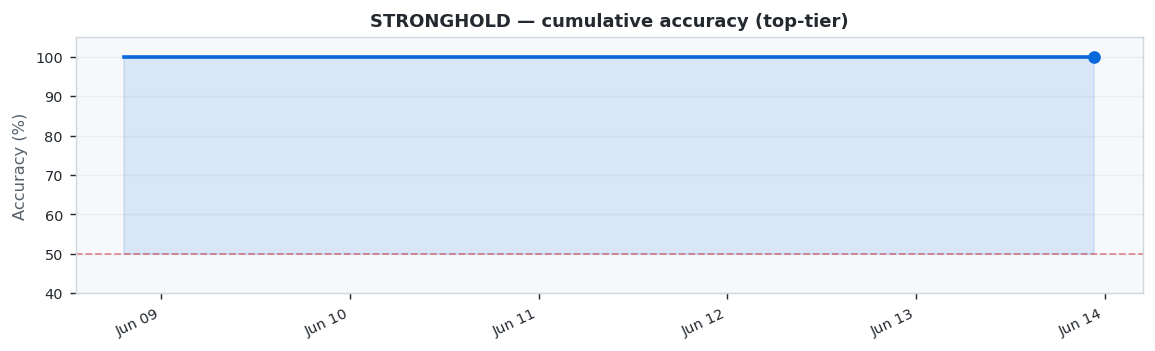
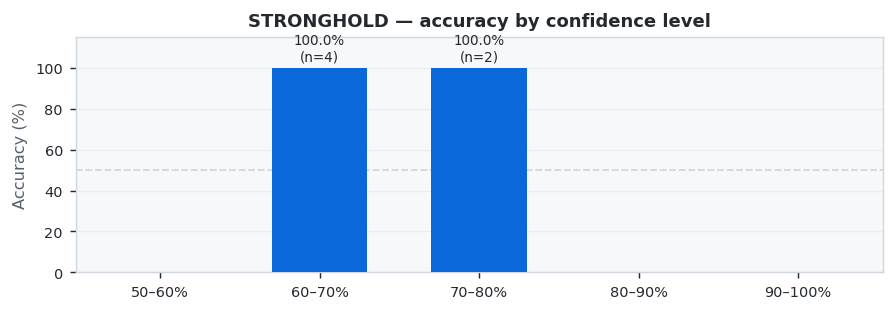
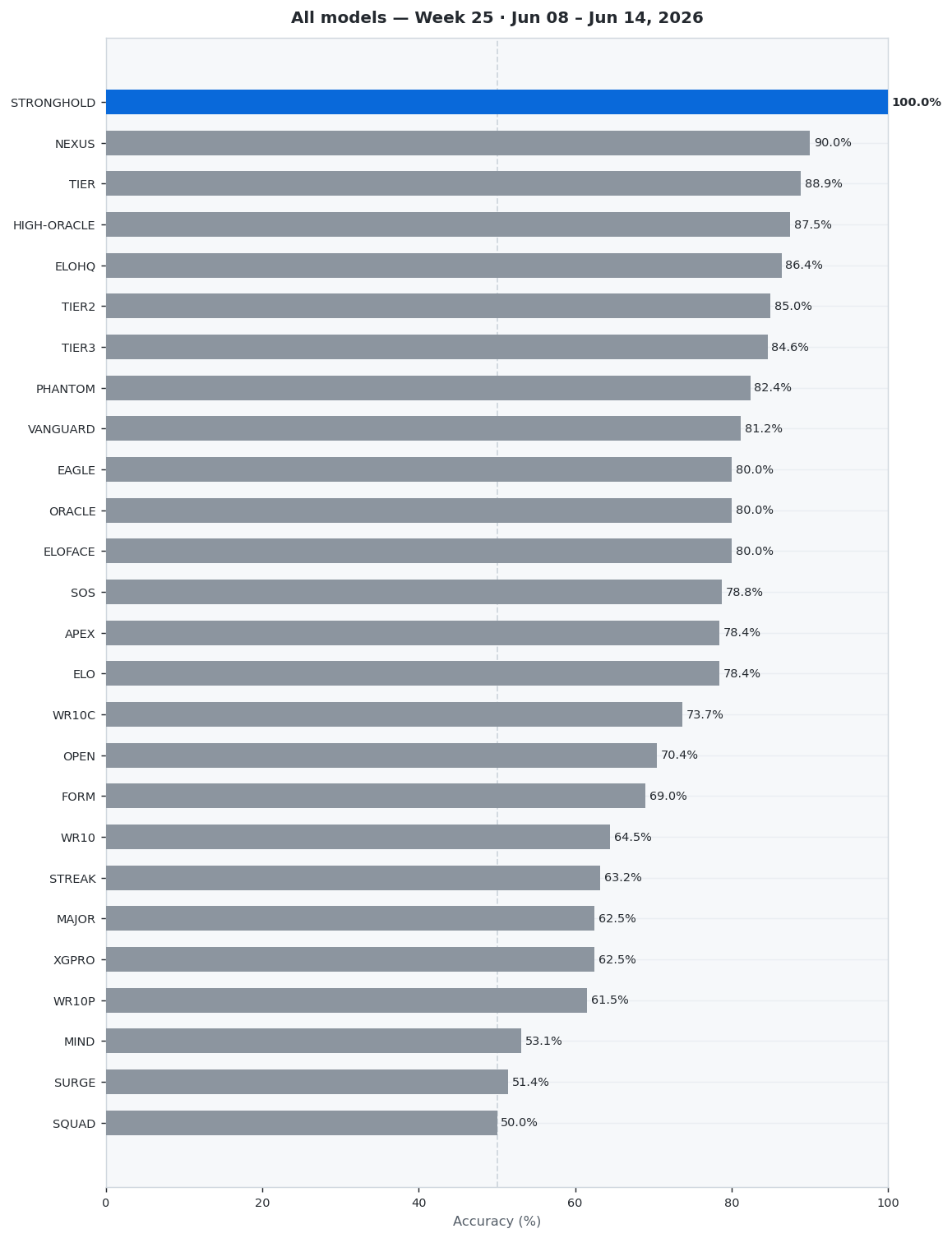
This week (Week 25 · Jun 08 – Jun 14, 2026) we analyzed 39 top-tier CS2 matches across 26 prediction models. STRONGHOLD dominated with 100.0% accuracy (6/6 correct), ahead of NEXUS at 90.0%. STRONGHOLD achieved a Brier Score of 0.0919 and Log Loss of 0.36.
🏆 Model of the Week: STRONGHOLD
STRONGHOLD had an outstanding week, correctly predicting 6 out of 6 matches.
STRONGHOLD showed excellent performance with 100.0% accuracy across 6 predictions (6 correct, 0 wrong).
📊 Full Rankings This Week
Complete model performance for the week. The leader is highlighted.
🎮 STRONGHOLD Predictions This Week
6/6 correct predictions on top-tier matches.
| MATCH | PREDICTION | RESULT |
|---|---|---|
| Spirit 2-1 9z | 73% Spirit | CORRECT |
| Vitality 2-1 MOUZ | 68% Vitality | CORRECT |
| Aurora 1-2 Spirit | 70% Spirit | CORRECT |
| Vitality 2-1 FUT | 75% Vitality | CORRECT |
| Legacy 2-0 TYLOO | 67% Legacy | CORRECT |
| G2 2-0 BIG | 66% G2 | CORRECT |
The Cologne Major's Legends Stage closed last weekend with a near-perfect AI run from TIERELO (12 out of 15 — our highest Pickem score so far). Stage 3 just opened with all 16 teams now at the LANXESS arena. Here's what worked, what flopped, and what the models think happens next.
Stage 2 results
| Outcome | Teams |
|---|---|
| 3-0 | FUT, Spirit |
| 3-1 / 3-2 | G2, 9z, BetBoom, B8, Monte, Legacy |
| 2-3 / 1-3 | BIG, paiN, TYLOO, MIBR, M80, Astralis |
| 0-3 | FlyQuest, GamerLegion |
🏆 TIERELO ran the table — 12/15
The story of Stage 2 is TIERELO. It is our highest Pickem score on cs2predict.gg so far — Stage 1's winner SENTINEL only managed 6/15. Here's TIERELO's bracket:
| Pick | Team | Result | Points |
|---|---|---|---|
| 🏆 3-0 | Spirit | ✓ Spirit went 3-0 | +4 |
| 💀 0-3 | FlyQuest | ✓ FlyQuest went 0-3 | +4 |
| ⚡ Advance (4/7) | G2, Legacy, Monte, B8 | ✓ all four advanced | +4 |
| ⚡ Advance (3 misses) | Astralis, GamerLegion, paiN | ✗ all eliminated | +0 |
| Total | 12/15 | ||
Why TIERELO worked here: The model weights tier-3 teams by their ELO relative to bracket peers (not absolute), so it catches the right "tier-1 underdog runs the bracket" signals. Spirit going 3-0 was a non-consensus call — most models had Vitality or another top seed as the safer perfect-Swiss pick. And FlyQuest as 0-3 was unloved by exactly the kinds of models that overweight HLTV rank.
Stage 2 leaderboard (top 6)
| # | Model | Score | 3-0 / 0-3 | Advance |
|---|---|---|---|---|
| 🥇 | TIERELO | 12 | ✓ / ✓ | 4 / 7 |
| 🥈 | WR10COMBO | 11 | ✓ / ✓ | 3 / 7 |
| 🥉 | SURGE | 8 | ✓ / ✗ | 4 / 7 |
| #4 | ELO | 7 | ✓ / ✗ | 3 / 7 |
| #5 | ELOFACE | 7 | ✓ / ✗ | 3 / 7 |
| #6 | ELOHQ | 7 | ✓ / ✗ | 3 / 7 |
SURGE (our newest PRO-tier model, launched right before Stage 2) debuts at 3rd place on its very first Pickem event — both lines correct except for the 0-3 call. Nice start.
Cumulative leaderboard (after Stage 2)
Two events in, the standings are starting to mean something:
| # | Model | Total Pts | Per event |
|---|---|---|---|
| 🥇 | WR10COMBO | 16 | 8.0 |
| 🥈 | TIERELO | 14 | 7.0 |
| 🥉 | TRIBUNAL | 10 | 5.0 |
| #4 | SENTINEL | 10 | 5.0 |
| #5 | TIER3ELO | 10 | 5.0 |
WR10COMBO is the only model on the site to nail both Pickem 4-point lines across two stages (3-0 and 0-3 in each event). Steady, dull, and almost certainly the one to bet on for Stage 3. Full table: /pickem/leaderboard/.
🔮 Stage 3 is live — predictions open
The Champions Stage just started in Cologne. 16 teams, BO3 throughout (a first for a CS2 Major), all Swiss, top 8 advance to playoffs. Field is the eight Stage 2 advancers (FUT, Spirit, G2, BetBoom, 9z, B8, Legacy, Monte) joined by the eight pre-qualified Champions seeds (Vitality, Natus Vincere, MOUZ, Falcons, FURIA, Aurora, The MongolZ, PARIVISION).
AI Consensus across our 28 models:
| Role | Consensus pick | Agree |
|---|---|---|
| 🏆 3-0 | Vitality | 16 / 28 (57%) |
| 💀 0-3 | BetBoom | 13 / 28 (46%) |
| ⚡ Top advancers | The MongolZ (82%), Falcons (75%), PARIVISION (64%), Natus Vincere (60%), MOUZ (60%), Spirit (57%), Aurora (53%) | |
The interesting story is BetBoom as consensus 0-3. They scraped through Stage 2 at 3-1 (avoiding elimination on the final map of their final match) and the models clearly read that as a fluke. If they go out 0-3 here, the models will look smart. If they make it through again, this becomes the Pickem upset of the Major.
And Vitality as 3-0 is mostly "trust the rank" — they're the world #1 entering Stage 3 and most models default to that. The interesting alternative comes from TIERELO (the Stage 2 winner) and a couple of others, who picked a different team to run the table. Click into /pickem/iem-cologne-major-2026-stage-3/ to see every model's individual bracket — and whether the meta-models that dominated Stage 2 agree on the upset call.
Predictions are live; the bracket fills in as the next four days play out. The cumulative leaderboard will update automatically once Stage 3 finalizes.
Heads-up: after Stage 3 closes (around June 14), the eight survivors head into a BO3 single-elim playoff bracket. We're working on a separate "champion / finalist / semifinalist" Pickem-style page for that — different scoring (4 + 4 + 1×2 = max 10), same idea.
Weekly digest · Top-tier CS2 matches · Week 24 · Jun 01 – Jun 07, 2026
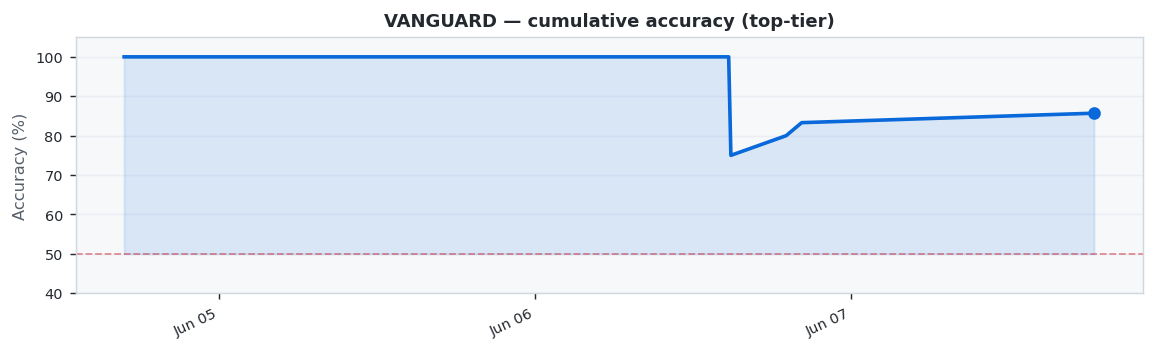
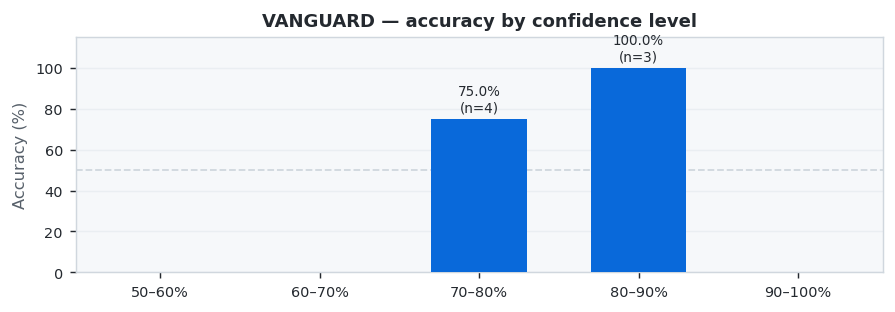
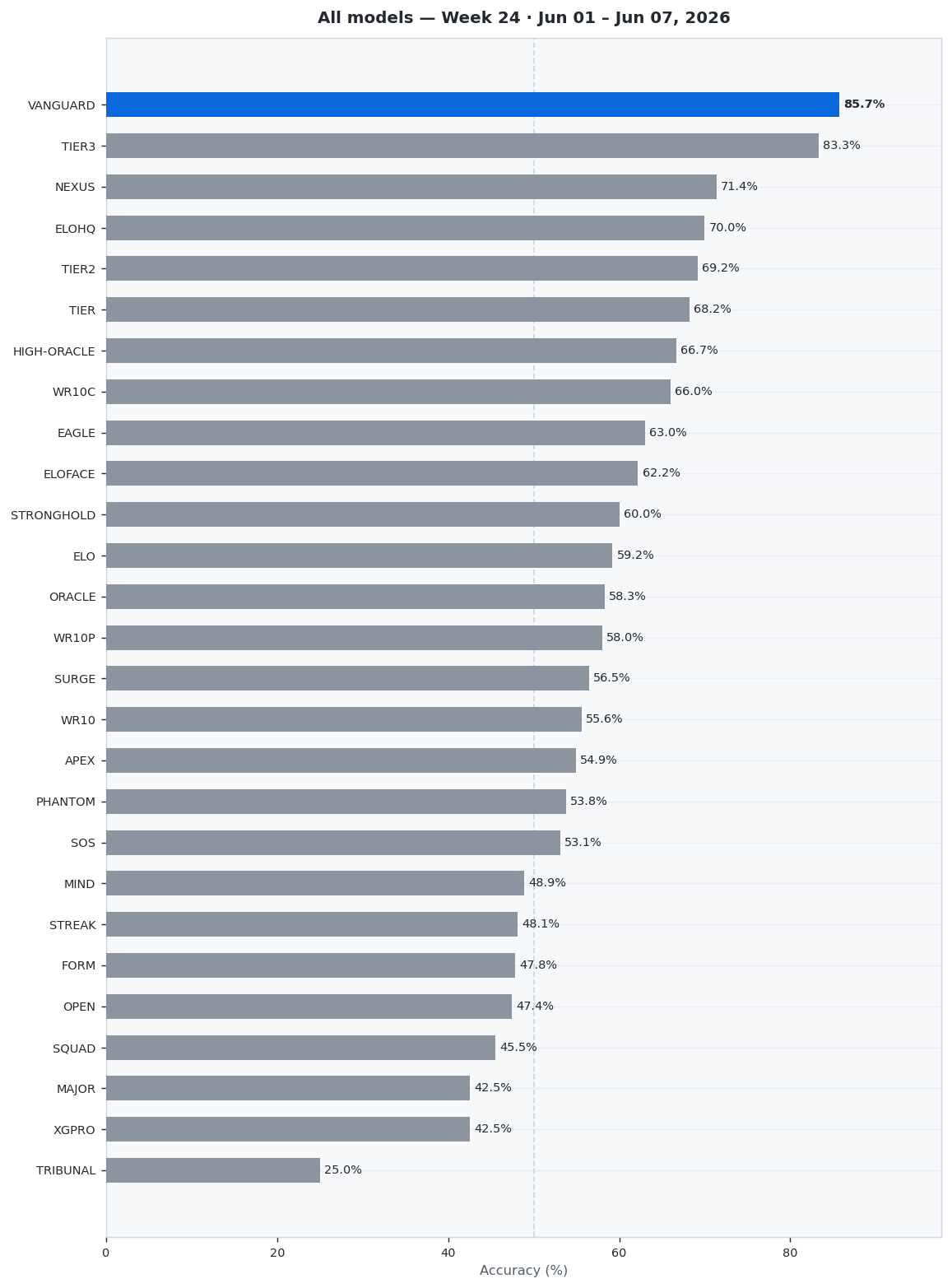
This week (Week 24 · Jun 01 – Jun 07, 2026) we analyzed 58 top-tier CS2 matches across 27 prediction models. VANGUARD dominated with 85.7% accuracy (6/7 correct), ahead of TIER3 at 83.3%. VANGUARD achieved a Brier Score of 0.1258 and Log Loss of 0.4174.
🏆 Model of the Week: VANGUARD
VANGUARD had an outstanding week, correctly predicting 6 out of 7 matches.
VANGUARD showed excellent performance with 85.7% accuracy across 7 predictions (6 correct, 1 wrong).
📊 Full Rankings This Week
Complete model performance for the week. The leader is highlighted.
🎮 VANGUARD Predictions This Week
6/7 correct predictions on top-tier matches.
| MATCH | PREDICTION | RESULT |
|---|---|---|
| Spirit 2-0 9z | 79% Spirit | CORRECT |
| Spirit 13-1 MIBR | 87% Spirit | CORRECT |
| Legacy 13-7 FlyQuest | 80% Legacy | CORRECT |
| Legacy 8-13 MIBR | 79% Legacy | WRONG |
| Spirit 13-5 BetBoom | 84% Spirit | CORRECT |
| 9z 13-9 FlyQuest | 77% 9z | CORRECT |
| GamerLegion 2-0 BIG | 73% GamerLegio | CORRECT |
Weekly leaderboard · Week 23 results (Jun 01 – Jun 07, 2026) · published Week 24
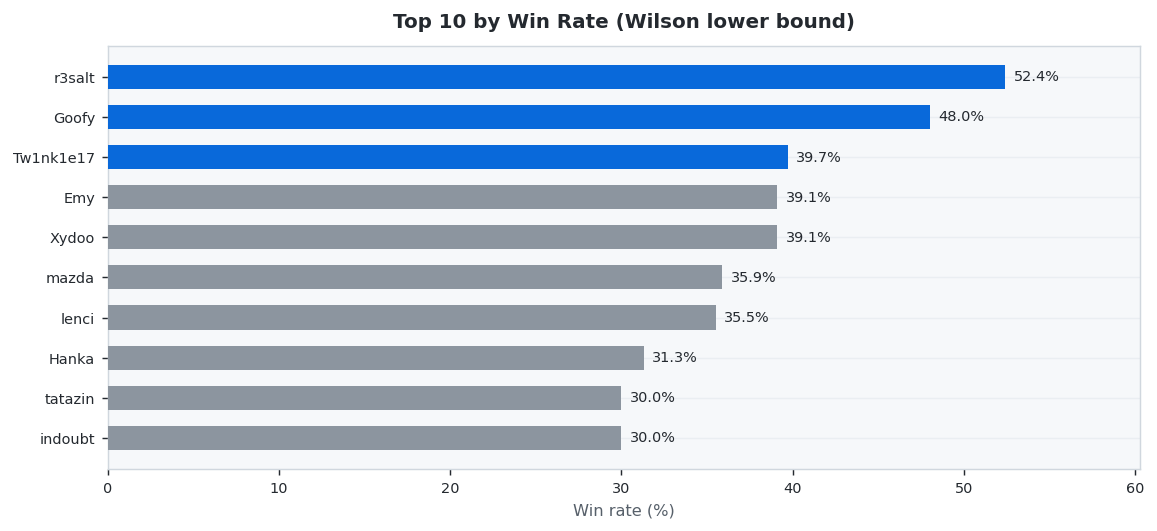
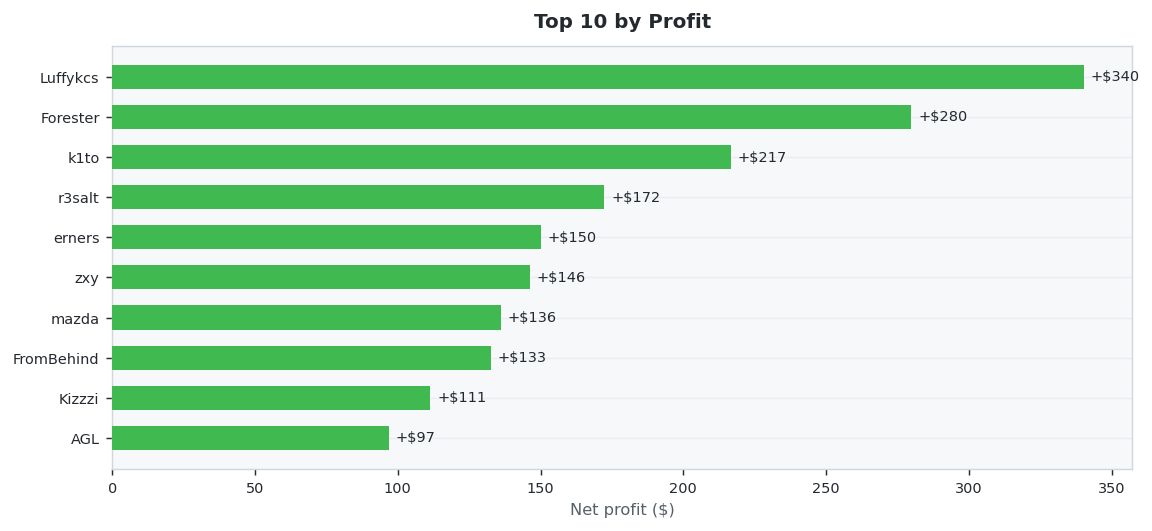
47 predictors placed 445 settled wagers this week (Week 23 results (Jun 01 – Jun 07, 2026) · published Week 24). r3salt led on accuracy at 52.4% Wilson, while Luffykcs netted +$340.22 in profit. Average accuracy across the field: 22.5%.
🎯 Win Rate Champion
Highest accuracy by Wilson lower bound (3+ settled wagers required to qualify).
💵 Profit Champion
Highest net USD return (winnings minus stakes). Green bars are winners, red are net losers.
Want next week's prize?
Top-1 in each category wins +$20. Place 3+ predictions on the match list · check the live leaderboard.
Following up on our Stage 1 launch post, the IEM Cologne Major 2026 Stage 1 Swiss has wrapped. Here's what 27 AI models actually got right — and the new Pickem Leaderboard we just launched to track all of this going forward.
The actual Stage 1 outcome
Stage 1 produced two 3-0 teams, two 0-3 teams, and six advancers:
- 3-0: B8, BetBoom
- 0-3: SINNERS, Gaimin Gladiators
- Advanced (3-1 / 3-2): GamerLegion, MIBR, BIG, TYLOO, M80, FlyQuest
- Eliminated (1-3 / 2-3): HEROIC, Lynn Vision, Liquid, Sharks, NRG, THUNDER dOWNUNDER
The big upset: HEROIC
The story of Stage 1 is HEROIC. They were the consensus 3-0 pick from 12 of 27 models — the heaviest concentration of any team on any pick. They went out at 1-3.
Meanwhile B8, who only one model (SENTINEL) called for 3-0, ran the table perfectly. That single non-consensus call is the entire reason SENTINEL won the event.
Top scorers — Stage 1
| # | Model | Pts | 3-0 pick | 0-3 pick | Advance |
|---|---|---|---|---|---|
| 🥇 | SENTINEL | 6 | B8 ✓ | BetBoom ✗ | 2 / 7 |
| 🥈 | WR10COMBO | 5 | GamerLegion ✗ | SINNERS ✓ | 1 / 7 |
| 🥉 | HIGHORACLE | 4 | HEROIC ✗ | GamerLegion ✗ | 4 / 7 |
Three observations:
- SENTINEL is the only model that scored on the 3-0 line. It picked B8 — a team almost every other model rated as a fringe advancer at best.
- WR10COMBO was the only model to nail the 0-3 line (SINNERS). That single +4 pts vaulted it to second despite a weak advance count.
- HIGHORACLE has the highest advance hit-rate (4/7) but missed both anchors. Solid mid-tier judgment, weak on extremes — a classic "play it safe" profile.
Introducing the Pickem Leaderboard
From now on, every model's Pickem performance accumulates across all completed Majors. The new /pickem/leaderboard/ page ranks all 27 models by cumulative HLTV-rule points, and each row is clickable for a per-event breakdown: who they picked, who they should have picked, and exactly how their score was assembled.
The leaderboard is permanent. Stage 2 results will roll in. So will every Major after that. The story of which AI model is actually the best at Pickem will be told over many events, not one.
What's next
- Stage 2 predictions are already live — 27 models forecast the next Swiss bracket with the same 10,000-run Monte Carlo machinery, now informed by Stage 1's roster shake-up.
- SURGE, our newest PRO model (launch post), is in the mix from Stage 2 onward — it uses a novel signal: the steepest player-level form trajectory on each side. It missed Stage 1 but you'll see it on the leaderboard going forward.
- A user-facing Pickem contest (you make your own picks, models score alongside you) is in the pipeline.
tl;dr — Stage 1 favored the model that took a non-consensus swing. SENTINEL won by being the only model to call B8 perfect. The full leaderboard is at cs2predict.gg/pickem/leaderboard/.
We've added a new model to CS2PREDICT: SURGE. Unlike ELO, rank, or even SQUAD (which averages player ratings), SURGE looks at how fast individual players are improving — capturing a "hot-hand" signal that no other model on the site sees.
What SURGE measures
For each starter on a team, SURGE computes the difference between their K-D differential over their last 3 matches versus matches 4-6 before. This is the player's recent trajectory — are they trending up or down?
Then SURGE takes the maximum across the team's five starters. A team with one player who's significantly improved his K-D in the last week is more dangerous than ELO suggests — and SURGE captures that.
How we found it
We ran a grid search over 400 hypothesis variants on 10 years of historical HLTV data — varying window sizes (3/5/7/10/15 matches), features (rating, ADR, KAST, K-D differential), and aggregations (mean/median/max/min). The winner across all robustness checks: recent 3 vs prior 3, K-D differential, team max.
Backtest performance
On a 1,973-match holdout of top-tier matches:
- SURGE standalone: 73.9% accuracy
- SURGE + ELO combined: 77.0% accuracy (+11.8 pp vs ELO alone)
- Bootstrap 95% CI: [75.1%, 78.7%]
- Correlation with ELO: 0.11 — essentially independent signal
That 0.11 correlation is the key result. It means SURGE is providing genuinely new information that ELO doesn't see. When two independent signals agree, their combined prediction is significantly stronger.
Why it works
ELO captures team-level Win/Loss outcomes — but it's slow to update and averages across the roster. SQUAD captures the level of player ratings but not the trend. SURGE captures the trend specifically of the best-improving player, which is what often drives upsets at the top of CS2 (one star catching fire can carry the team).
Availability
SURGE is available to Pro subscribers. Predictions will start showing up on upcoming matches within minutes of this post — the refresh daemon has already picked up the new model.
As live data accumulates, you'll see actual production accuracy on the model's page.
Monthly leaderboard · May 2026 results · published June 2026
47 predictors placed 2410 settled wagers this month. Paranormal led on accuracy at 50.8% Wilson WR, while tier0_s netted +$1043.99 in profit. Average accuracy across the field: 50.3%.
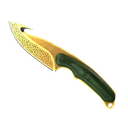
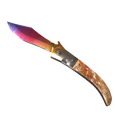
🔪 Knife Giveaway Winners
🎯 Win Rate Champion
Highest accuracy by Wilson lower bound (5+ settled wagers required for the knife giveaway).
- 🥇 Paranormal — 50.8% Wilson (23W / 11L)
- 🥈 Tw1nk1e17 — 50.2% Wilson (45W / 28L)
- 🥉 seberya — 48.7% Wilson (51W / 35L)
💵 Profit Champion
Highest net USD return (winnings minus stakes).
- 🥇 tier0_s — +$1043.99 (77 bets)
- 🥈 k1to — +$783.59 (63 bets)
- 🥉 tatazin — +$670.20 (47 bets)
What's next
The Knife Giveaway was a one-month special. $50 / $50 monthly cash prizes for Top Win Rate and Top Profit continue throughout June — same eligibility (3+ settled predictions). Place predictions on the match list and track standings on the Leaderboard.
Big thanks to everyone who placed predictions in May. See you on the June board.
Weekly digest · Top-tier CS2 matches · Week 23 · May 25 – May 31, 2026
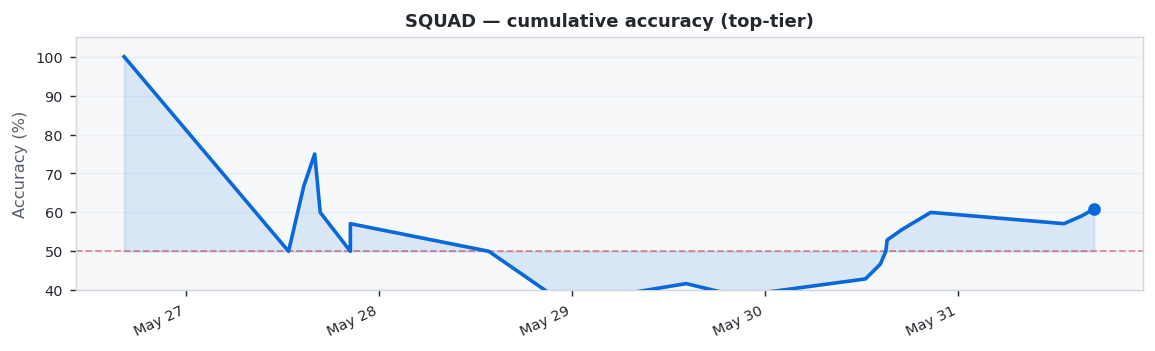
This week (Week 23 · May 25 – May 31, 2026) we analyzed 23 top-tier CS2 matches across 24 prediction models. SQUAD dominated with 60.9% accuracy (14/23 correct), ahead of MIND at 50.0%. SQUAD achieved a Brier Score of 0.2732 and Log Loss of 0.8257.
🏆 Model of the Week: SQUAD
SQUAD edged out the competition this week, though accuracy across all models was moderate.
SQUAD showed decent performance with 60.9% accuracy across 23 predictions (14 correct, 9 wrong).
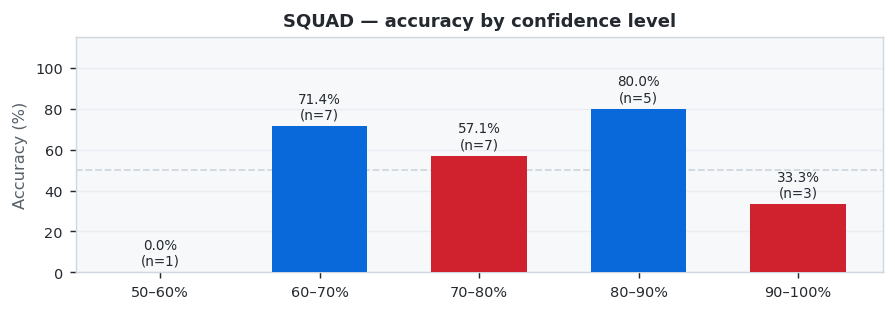
📊 Full Rankings This Week
Complete model performance for the week. The leader is highlighted.
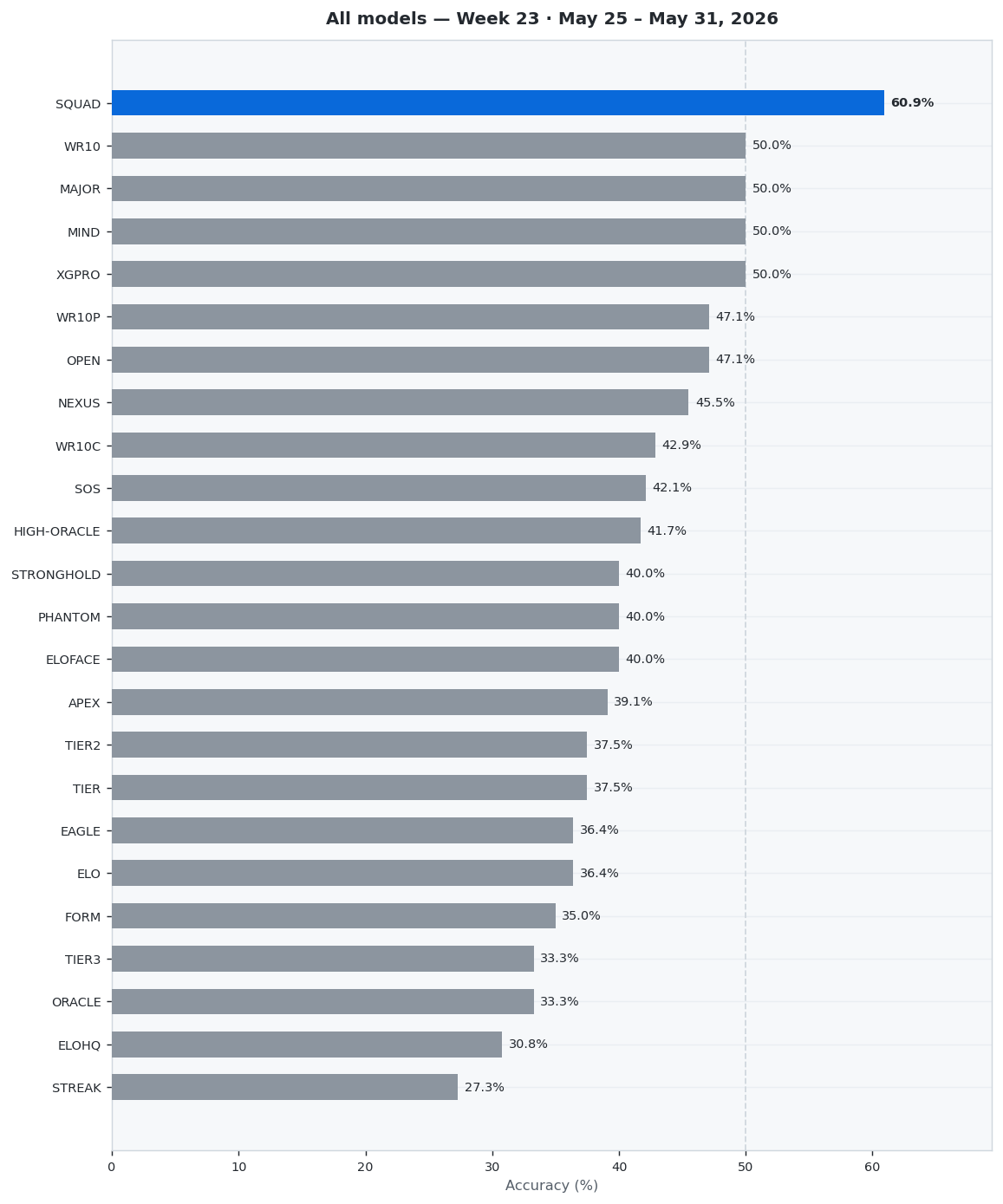
🎮 SQUAD Predictions This Week
14/23 correct predictions on top-tier matches.
| MATCH | PREDICTION | RESULT |
|---|---|---|
| FOKUS 2-1 Nemiga | 90% FOKUS | CORRECT |
| Gentle Mates 0-2 Nemesis | 81% Nemesis | CORRECT |
| TDK 2-1 OG | 71% OG | WRONG |
| 100 Thieves 1-2 Nemesis | 67% Nemesis | CORRECT |
| magic 1-2 Ninjas in Pyjamas | 72% Ninjas in | CORRECT |
| FOKUS 2-1 fnatic | 77% FOKUS | CORRECT |
| Gentle Mates 2-0 GenOne | 89% Gentle Mat | CORRECT |
| Ninjas in Pyjamas 2-0 FaZe | 67% Ninjas in | CORRECT |
| Tricked 0-2 Nemiga | 89% Nemiga | CORRECT |
| Gentle Mates 2-1 Eternal Fire | 79% Gentle Mat | CORRECT |
| FaZe 2-0 Sharks | 70% Sharks | WRONG |
| 9z 1-2 FaZe | 68% FaZe | CORRECT |
| Nemesis 2-3 TDK | 88% Nemesis | WRONG |
| magic 2-1 FaZe | 56% FaZe | WRONG |
| HEROIC 1-2 9z | 72% HEROIC | WRONG |
| 3DMAX 1-2 Alliance | 93% 3DMAX | WRONG |
| 9z 1-2 Sharks | 83% Sharks | CORRECT |
| Eternal Fire 2-1 fnatic | 77% fnatic | WRONG |
| FaZe 2-0 Alliance | 61% Alliance | WRONG |
| Gentle Mates 2-0 ALGO | 73% Gentle Mat | CORRECT |
| HEROIC 0-2 Ninjas in Pyjamas | 64% Ninjas in | CORRECT |
| 3DMAX 0-2 magic | 96% 3DMAX | WRONG |
| fnatic 2-0 Rune Eaters | 64% fnatic | CORRECT |
🤔 Why every model struggled this week
60.9% as the best model is the lowest weekly leader we've ever recorded on cs2predict.gg — normal weeks see the top model land between 75% and 85%. The drop wasn't a data glitch (we verified every match against HLTV directly). It was a real upset wave driven by an unusually packed tournament calendar.
Three top-tier events ran in parallel this stretch:
- CS Asia Championships 2026
- IEM Atlanta 2026
- PGL Astana 2026
Plus Major qualifiers leading into Cologne. Top organisations split rosters, tested experimental lineups, and showed visible signs of late-season fatigue. The result: 7 matches where every single one of 18–22 active models was wrong.
The 7 matches that broke the week
| Match | Tournament | What happened |
|---|---|---|
| MongolZ vs B8 | CS Asia Championships | B8 won 2-1 (huge upset) |
| MIBR vs PARIVISION | CS Asia Championships | MIBR ran out 2-0 |
| NaVi vs Vitality | IEM Atlanta | NaVi took it 2-1 |
| B8 vs FUT | IEM Atlanta | B8 won 2-0 again |
| PARIVISION vs G2 | PGL Astana | G2 needed 3 maps |
| PARIVISION vs 9z | PGL Astana | 9z swept 2-0 |
| Aurora vs HEROIC | PGL Astana | HEROIC took it 2-0 |
The pattern: B8 (Ukrainian Tier-2) and PARIVISION (rising Russian roster) were involved in 5 of 7 of these matches. B8 ran the Cinderella story — taking down both MongolZ AND FUT in the same week.
Why SQUAD held up better
When ELO-based, rank-based, and form-based models all converge on the same prediction and are all wrong, the only model that can stand out is one looking at something different. SQUAD does exactly that: it weights individual player ratings rather than team-level rank.
For a week dominated by:
- Rosters with new players (player ratings hadn't caught up to team rank)
- Substitute lineups (team rank was misleading)
- Tier-2 squads with strong individuals punching above their rank
SQUAD's player-first approach happened to fit. 60.9% isn't great absolutely — it's just that team-based models did far worse, because their signals were polluted by mid-tournament roster changes.
What this means going forward
CS2's 2026 calendar is more packed than ever. When 3+ tournaments overlap, expect lower model agreement, more upsets in matches where rosters changed mid-week, and player-based models (SQUAD, WR10) gaining a temporary edge.
We're not adjusting any model weights based on a single week — that would be classic over-fitting. But it's a useful reminder: models are statistical, not magical. Stable meta produces high accuracy. Chaotic weeks produce chaotic predictions.
Major Cologne Stage 1 kicks off this week (June 2). It'll be interesting to see how models behave once the scene refocuses on one big event.
Monthly digest · Top-tier CS2 matches · June 2026
Based on May 2026 data, we tracked 139 top-tier CS2 matches across 26 prediction models with a total of 2456 predictions. The average model accuracy was 64.0%, with a spread of 27.6% between the best and worst performing models.
🏆 Top 3 Models of the Month
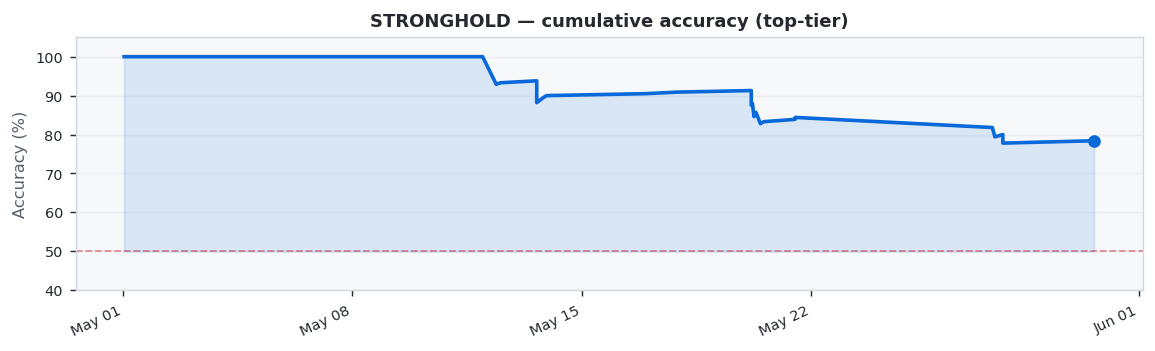
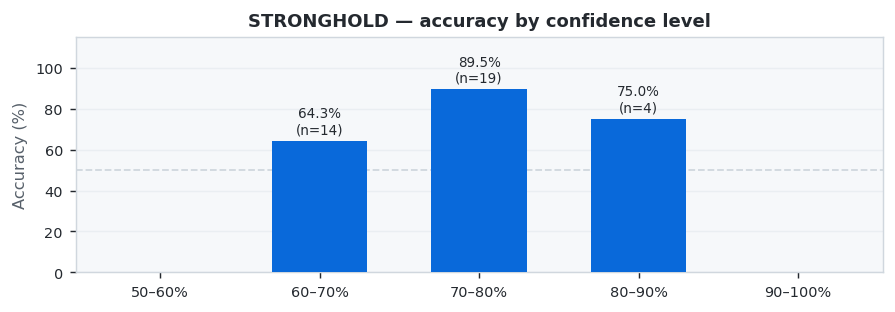
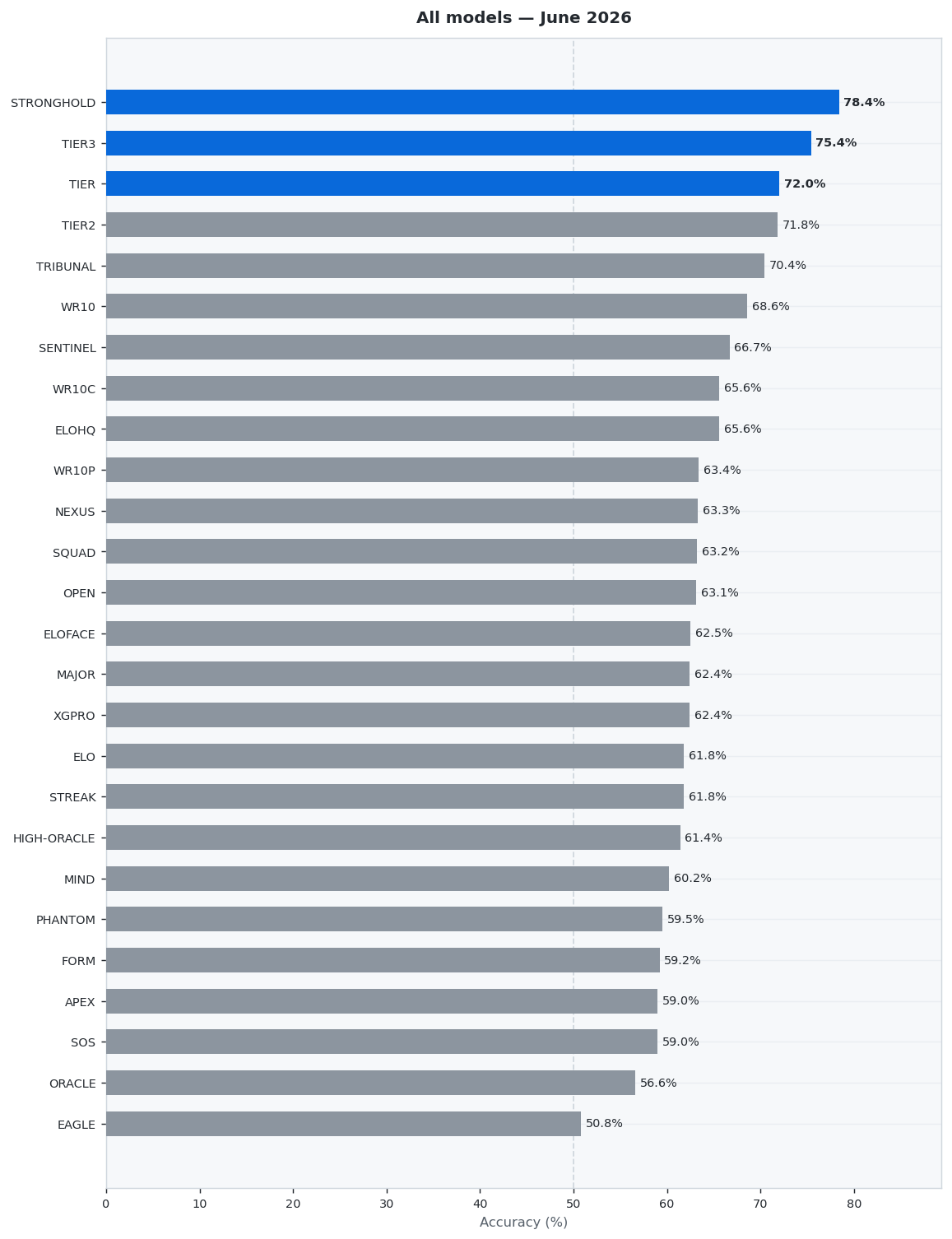
STRONGHOLD takes the top spot with 78.4% accuracy, followed by TIER3 at 75.4% and TIER at 72.0%.
STRONGHOLD showed excellent performance with 78.4% accuracy across 37 predictions (29 correct, 8 wrong). Best week: W18 at 100.0%, weakest: W22 at 40.0%.
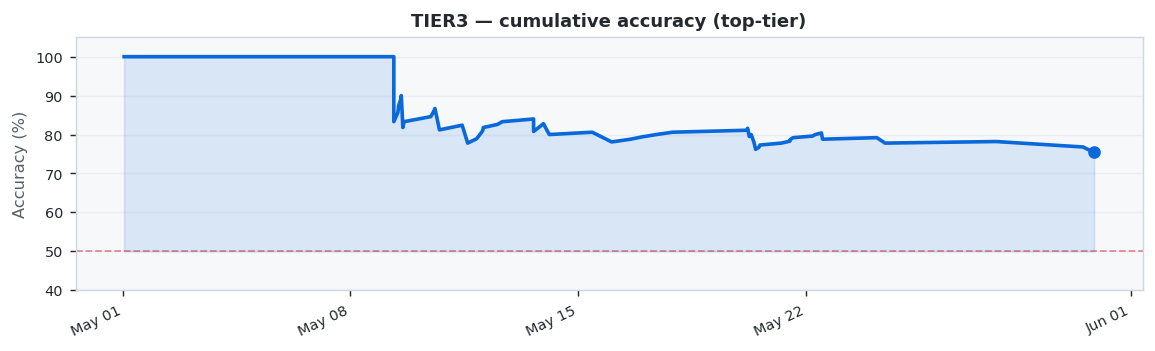
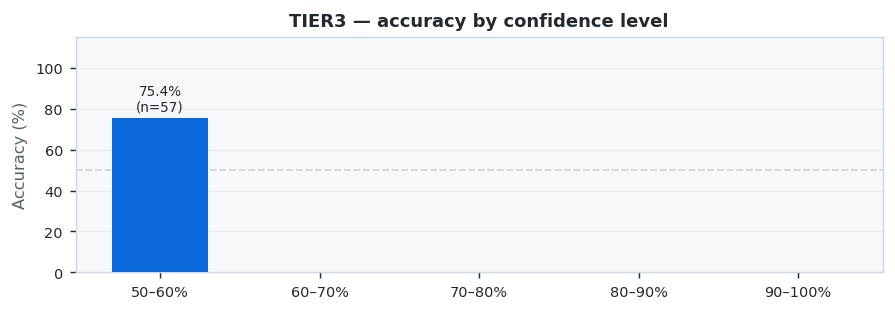
TIER3 showed excellent performance with 75.4% accuracy across 57 predictions (43 correct, 14 wrong). Best week: W18 at 100.0%, weakest: W22 at 33.3%.
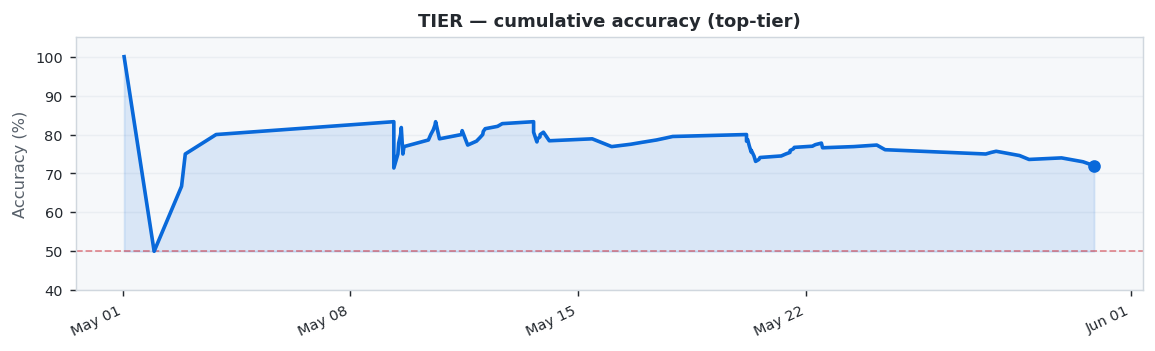
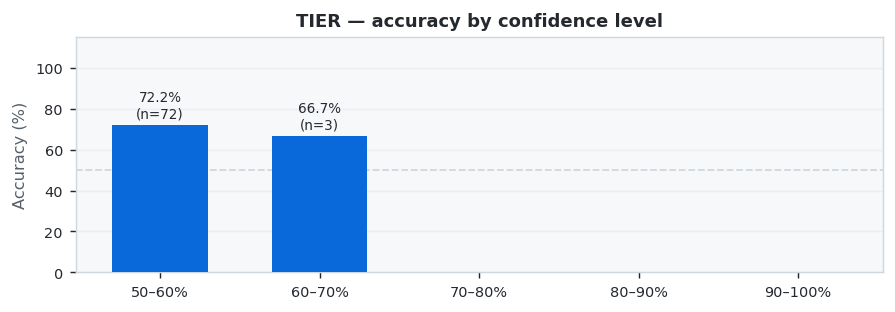
TIER showed strong performance with 72.0% accuracy across 75 predictions (54 correct, 21 wrong). Best week: W18 at 80.0%, weakest: W22 at 37.5%.
📊 Full Monthly Leaderboard
Below is the complete ranking of all models. Models highlighted in blue are in the top 3. The bar chart shows relative performance at a glance.
Weekly leaderboard · Week 22 results (May 25 – May 31, 2026) · published Week 23
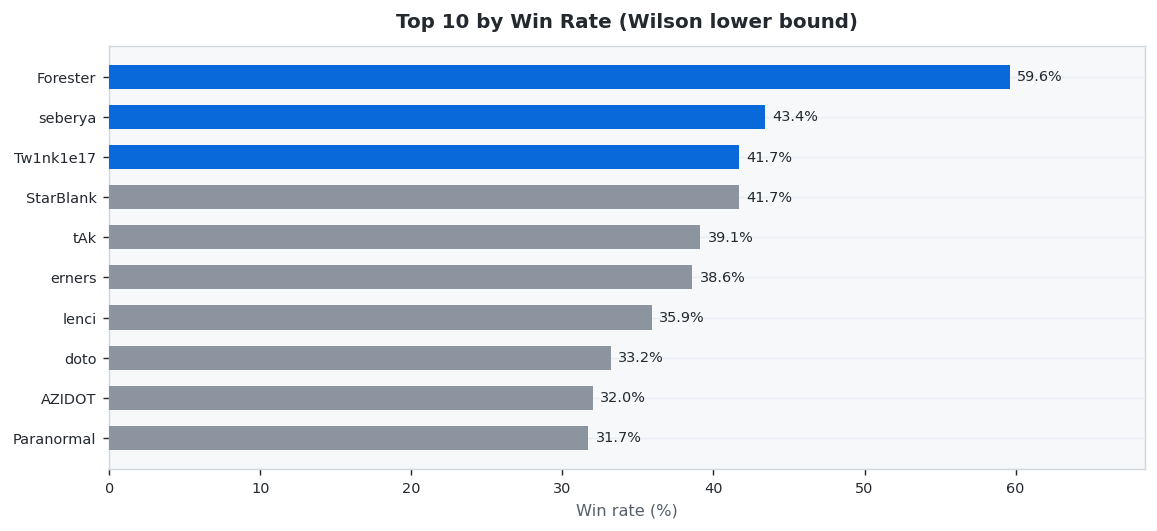
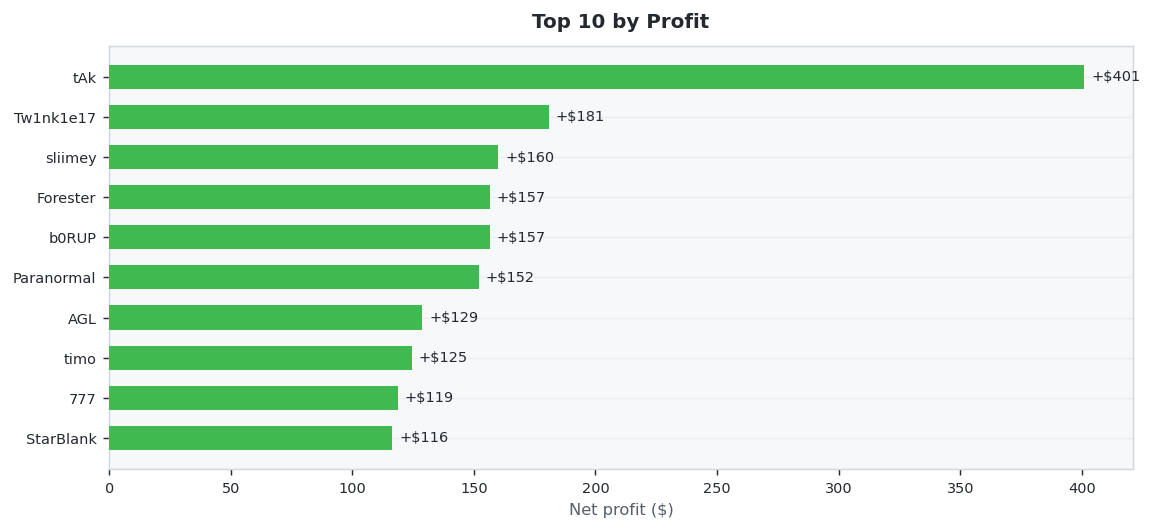
47 predictors placed 537 settled wagers this week (Week 22 results (May 25 – May 31, 2026) · published Week 23). Forester led on accuracy at 59.6% Wilson, while tAk netted +$400.96 in profit. Average accuracy across the field: 24.6%.
🎯 Win Rate Champion
Highest accuracy by Wilson lower bound (3+ settled wagers required to qualify).
💵 Profit Champion
Highest net USD return (winnings minus stakes). Green bars are winners, red are net losers.
Want next week's prize?
Top-1 in each category wins +$20. Place 3+ predictions on the match list · check the live leaderboard.
Weekly digest · Top-tier CS2 matches · Week 22 · May 18 – May 24, 2026
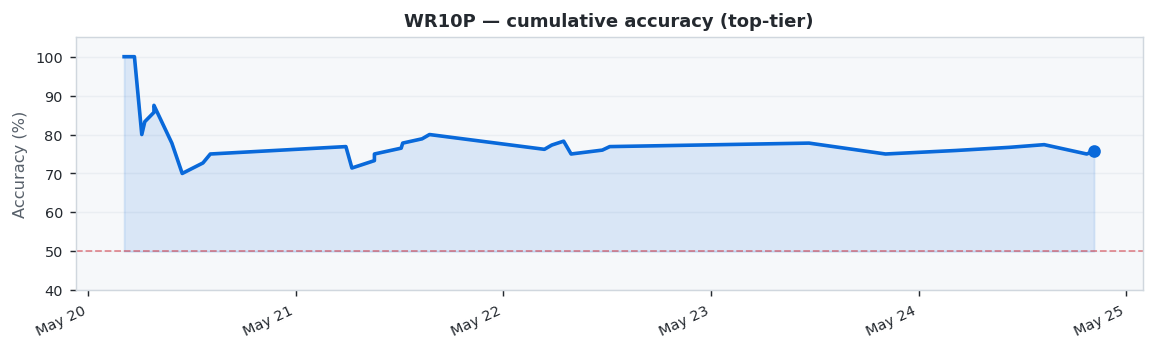
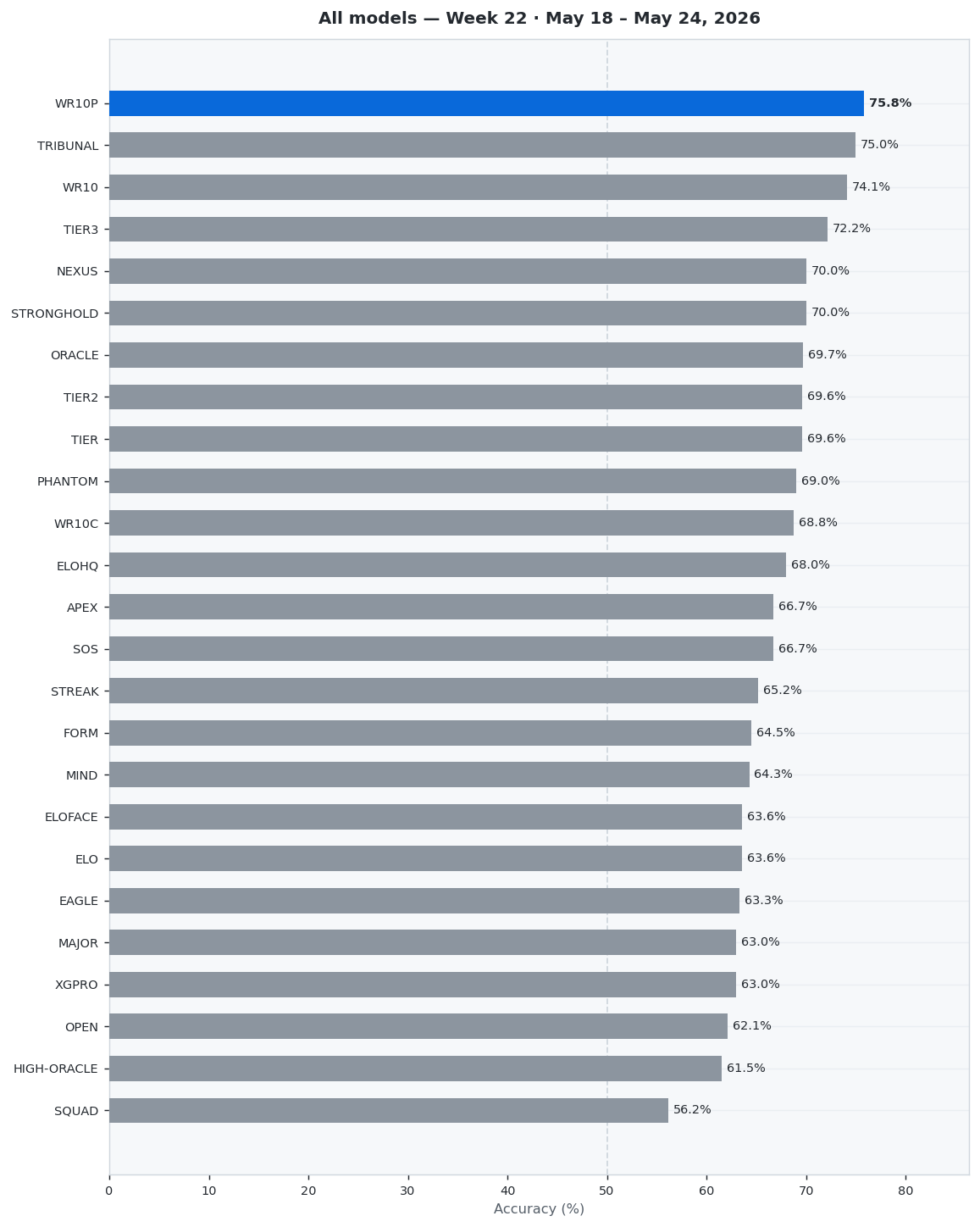
This week (Week 22 · May 18 – May 24, 2026) we analyzed 34 top-tier CS2 matches across 25 prediction models. WR10P dominated with 75.8% accuracy (25/33 correct), ahead of TRIBUNAL at 75.0%. WR10P achieved a Brier Score of 0.1981 and Log Loss of 0.5864.
🏆 Model of the Week: WR10P
WR10P had an outstanding week, correctly predicting 25 out of 33 matches.
WR10P showed excellent performance with 75.8% accuracy across 33 predictions (25 correct, 8 wrong).
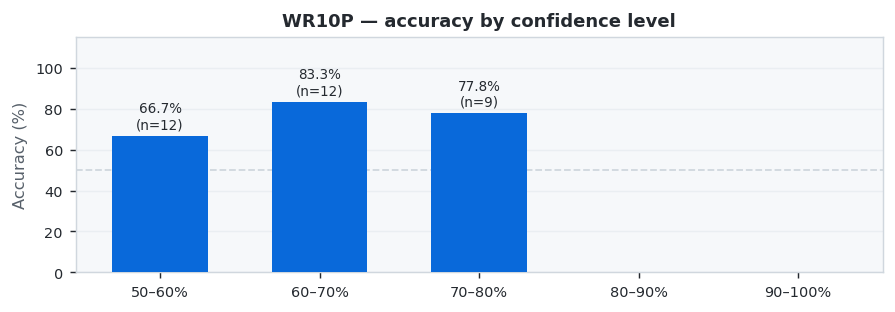
📊 Full Rankings This Week
Complete model performance for the week. The leader is highlighted.
🎮 WR10P Predictions This Week
25/33 correct predictions on top-tier matches.
Weekly leaderboard · Week 21 results (May 18 – May 24, 2026) · published Week 22
💰 Weekly Cash Prizes
47 predictors placed 555 settled wagers this week (Week 21 results (May 18 – May 24, 2026) · published Week 22). Paranormal led on accuracy at 57.8% Wilson, while Paranormal netted +$296.61 in profit. Average accuracy across the field: 27.0%.
🎯 Win Rate Champion
Highest accuracy by Wilson lower bound (3+ settled wagers required to qualify).
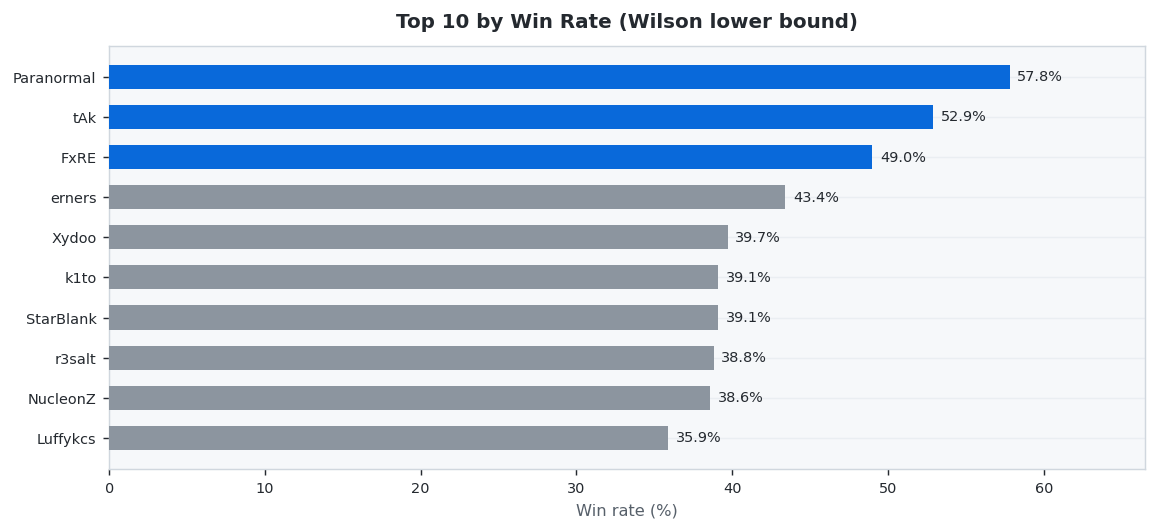
- 🥇 Paranormal — 57.8% Wilson (11W / 2L)
- 🥈 tAk — 52.9% Wilson (7W / 1L)
- 🥉 FxRE — 49.0% Wilson (8W / 2L)
💵 Profit Champion
Highest net USD return (winnings minus stakes). Green bars are winners, red are net losers.
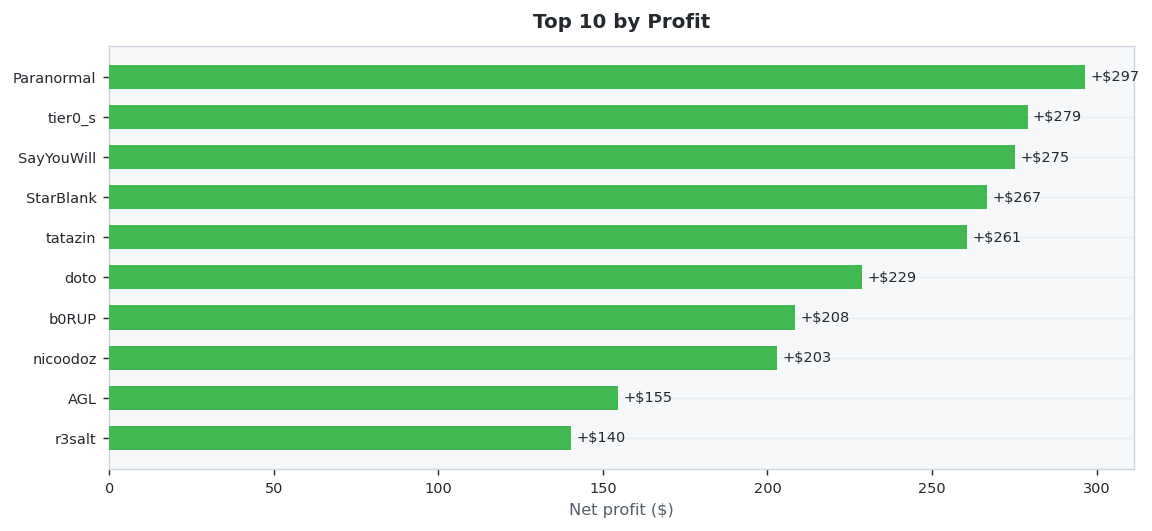
- 🥇 Paranormal — +$296.61 (13 bets)
- 🥈 tier0_s — +$279.12 (15 bets)
- 🥉 SayYouWill — +$275.34 (9 bets)
Want next week's prize?
Top-1 in each category wins +$20. Place 3+ predictions on the match list · check the live leaderboard.
Based on your feedback and requests, we've reshuffled the model lineup across subscription tiers — to make more useful models available right away without a subscription, and to give BASIC subscribers noticeably more options to work with. Big thanks to everyone who wrote in via support and Discord — this update is built directly from your suggestions.
Now available in FREE
- MIND — formerly BASIC
- OPEN — formerly BASIC
Even without a subscription, you now have two additional models with different decision logic, ready to try on upcoming matches.
Added to BASIC
- ELO — moved up from FREE
- WR10COMBO — moved up from FREE
- WR10, PHANTOM, APEX, STREAK, ORACLE — moved down from PRO
Five additional models that previously required PRO are now open to BASIC subscribers too.
What this means for you
- If you're on PRO: nothing changes — every model on the site is still available to you.
- If you're on BASIC: you now have 5 more models in your toolkit (WR10, PHANTOM, APEX, STREAK, ORACLE).
- If you're on FREE: MIND and OPEN are now yours — try them on the next few matches and see how they pick.
See the full lineup per tier on the Models leaderboard. Keep the feedback coming — it genuinely shapes how we develop the site.
We're rolling out a new section on CS2PREDICT: Pickem Predictions. Each CS2 Major has an Pickem Challenge — pick the team that goes 3-0, the team that goes 0-3, and the 7 teams that advance through the Swiss stage. Max 15 points (4 + 4 + 7). Hundreds of thousands of fans play it every Major. Now you can see what AI thinks before locking in your own pick.
What's live now: IEM Cologne Major 2026 — Stage 1
The Stage 1 (Challengers) page is up: /pickem/iem-cologne-major-2026-stage-1/
- AI Consensus — a quick "which team has the most model votes" view for each of the 9 Pickem slots. Pick the consensus choice if you want the safe play.
- Per-Model Picks — 27 AI models, each running 10,000 Monte Carlo simulations of the Swiss bracket and choosing its own 3-0/0-3/advance picks based on its match-level priors. Models ranked by their top-tier historical accuracy.
- Per-model deep-dive — click any model card to see the full 16-team probability matrix and confidence bars for that model's picks.
Coming soon: Stage 2 (Legends)
Stage 2 — the Legends stage with the 8 invited top-seeds joined by the 8 Stage-1 advancers — gets its own Pickem page as soon as the field is finalized on HLTV. Same format: AI consensus on top, per-model breakdown below. Watch this space.
What's next: user Pickem contest
We're planning a community Pickem challenge right alongside the AI: log in, submit your own 9 picks, and compete against the 27 models after the Major wraps. Final leaderboard will show user scores intermixed with AI scores — beat the algorithms and prove your CS2 sense.
Details (sign-up, prizes, timing) coming in a follow-up post. If you want a heads-up when entries open, log in and watch the Pickem section.
How AI predicts the Swiss bracket
Each model has its own per-match win-probability logic (ELO, recent form, head-to-head, tactical metrics). For Pickem we run 10,000 Monte Carlo simulations of the full 16-team Swiss bracket per model — every potential pairing flipped by a biased coin weighted by that model's match-level probability. The 3-0 pick = the team that finished without a loss most often, 0-3 = the team that finished winless most often, advance = top-7 by P(3-1 ∪ 3-2).
The simulation re-runs every time Cologne's seeding or team-strength data changes, until lock time (24h before the first Swiss match).
Weekly digest · Top-tier CS2 matches · Week 21 · May 11 – May 17, 2026
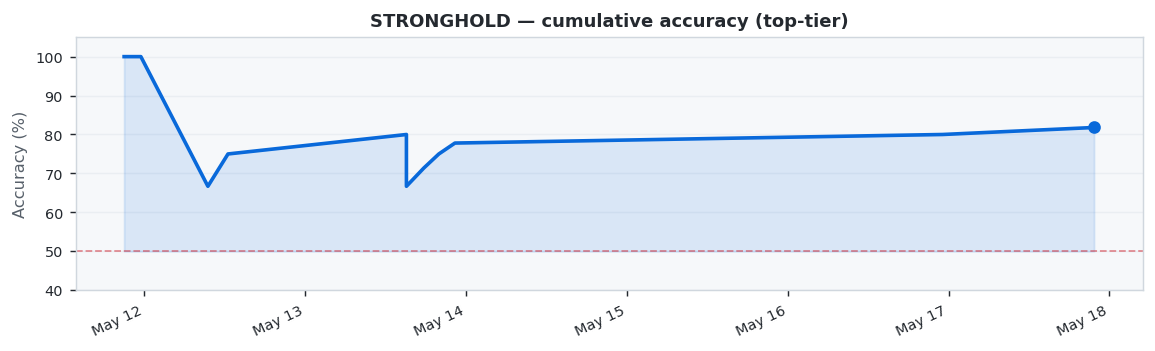
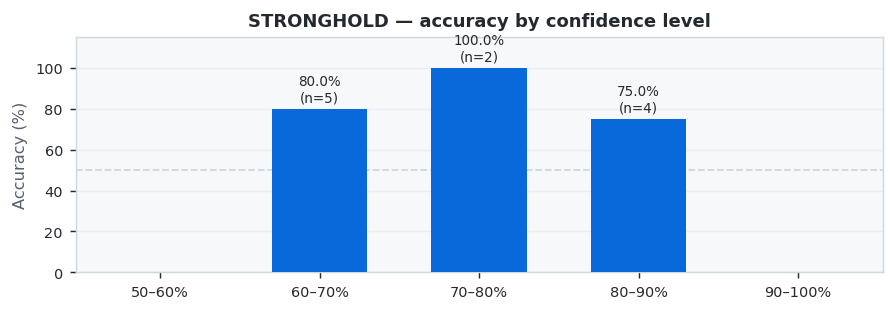
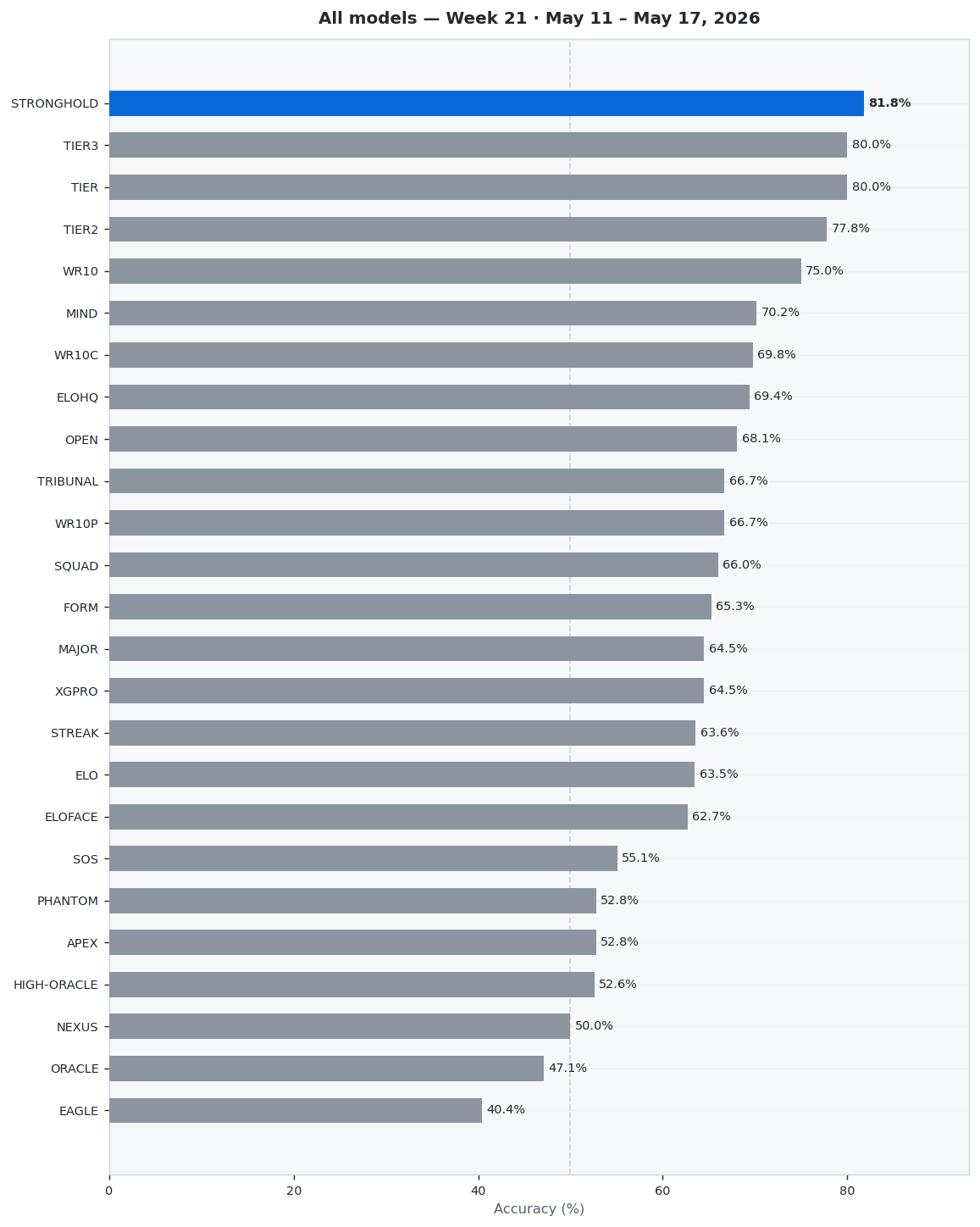
This week (Week 21 · May 11 – May 17, 2026) we analyzed 57 top-tier CS2 matches across 25 prediction models. STRONGHOLD dominated with 81.8% accuracy (9/11 correct), ahead of TIER at 80.0%. STRONGHOLD achieved a Brier Score of 0.1542 and Log Loss of 0.4943.
🏆 Model of the Week: STRONGHOLD
STRONGHOLD had an outstanding week, correctly predicting 9 out of 11 matches.
STRONGHOLD showed excellent performance with 81.8% accuracy across 11 predictions (9 correct, 2 wrong).
📊 Full Rankings This Week
Complete model performance for the week. The leader is highlighted.
🎮 STRONGHOLD Predictions This Week
9/11 correct predictions on top-tier matches.
| MATCH | PREDICTION | RESULT |
|---|---|---|
| GamerLegion 0-3 Natus Vincere | 68% Natus Vinc | CORRECT |
| BetBoom 0-2 Natus Vincere | 77% Natus Vinc | CORRECT |
| B8 0-2 Vitality | 80% Vitality | CORRECT |
| SINNERS 0-2 Astralis | 70% Astralis | CORRECT |
| FaZe 0-2 Vitality | 81% Vitality | CORRECT |
| BetBoom 2-1 Vitality | 83% Vitality | WRONG |
| Natus Vincere 2-1 GamerLegion | 69% Natus Vinc | CORRECT |
| Monte 2-1 The Huns | 67% Monte | CORRECT |
| HEROIC 1-2 magic | 62% HEROIC | WRONG |
| Natus Vincere 2-0 Passion UA | 74% Natus Vinc | CORRECT |
| Vitality 2-0 BC.Game | 84% Vitality | CORRECT |